Most Florida foreclosure investors walk away from a successful Clerk of the Circuit Court auction believing the Certificate of Title is a clean slate. The foreclosing lender filed suit, named the defendants, obtained a judgment, the auction ran, the certificate issued. Every junior lien beneath the plaintiff's mortgage is gone. That is the standard assumption, and even experienced buyers who have closed dozens of properties hold it.
It is legally incomplete. And the gap can cost you six figures on a single deal.
The mechanism that makes this assumption dangerous is not buried in obscure case law. It sits in Florida's service of process statute and in a 1983 U.S. Supreme Court decision. Understanding it takes about ten minutes. Missing it means you can inherit a lien that survived the sale intact, attached to the property you just bought.
The core assumption and where it breaks
Florida runs judicial foreclosures. A lender files a complaint in circuit court, names all parties with a recorded interest in the property as defendants, gets a final judgment of foreclosure, and the Clerk of the Circuit Court schedules and conducts the auction. The general rule is that a final judgment of foreclosure extinguishes the interests of all parties who were properly made defendants in the action.
That word "properly" is the trap.
If a junior lienholder was not served with process in the foreclosure action, or was served at the wrong address, they are not bound by the final judgment. The Certificate of Title does not extinguish their lien. It attaches to the property and transfers automatically to the new owner.
That new owner is you.
This is not a hypothetical. It happens in Florida foreclosure auctions regularly enough that quiet title actions are a recognized follow-on cost for buyers who miss the due diligence step. The frustrating part is that the exposure is almost entirely visible before you bid, if you know where to look.
Fla. Stat. §49.011: the service requirement
Florida Statute §49.011 governs who must be named as a defendant and served in a mortgage foreclosure action. The short version: every person or entity with a recorded interest in the property must be joined and properly served with process.
That list runs longer than most investors expect. It includes the primary mortgagor, second mortgage holders, judgment creditors with recorded liens against the owner, contractors and subcontractors with recorded construction liens, homeowners associations with recorded assessment liens, and any other party whose interest appears in the chain of title or is otherwise reasonably ascertainable.
The plaintiff's attorney is responsible for running a thorough title search before filing the complaint and identifying all lienholders. In practice, that search is not always complete or current. Liens filed close to the foreclosure filing date get missed. Out-of-state judgment creditors are harder to locate and serve properly. HOA contacts go stale when management companies turn over between the lien recording and the service attempt.
When any of these parties are skipped in the pleadings and never served, the foreclosure proceeds without them. Their lien is not before the court. The court has no jurisdiction to extinguish it. The lien survives.
Mennonite Board of Missions v. Adams (1983): the constitutional floor
The statutory requirement has a constitutional backstop that courts take seriously.
In Mennonite Board of Missions v. Adams, 462 U.S. 791 (1983), the U.S. Supreme Court held that a mortgagee whose interest is reasonably identifiable from public records is entitled to actual notice before a tax sale extinguishes that interest. Publication alone does not satisfy due process when the creditor's address can be found with a reasonable search of the public record.
The principle extends to judicial foreclosures. A creditor with a recorded lien has a constitutionally protected property interest. Due process requires that they receive meaningful notice before that interest is terminated. Florida courts have consistently applied this standard. A plaintiff who omits a recorded junior lienholder has not just made a procedural oversight. They have deprived that creditor of their constitutional rights. That creditor is not bound by the judgment. Their lien survives the Certificate of Title.
This is the root cause of post-auction quiet title actions in Florida. When a buyer discovers a surviving lien after closing, the remedy is a quiet title suit to clear the title, which takes months and real legal fees even when you ultimately prevail. Prevention is pulling the docket and running the title search before you bid.
Three scenarios where service failure is most common
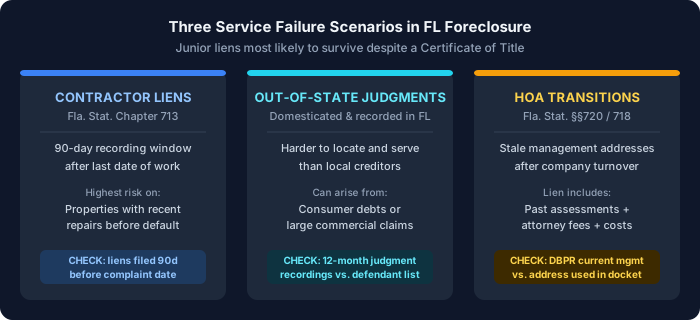
Contractor liens filed close to the foreclosure date.
Under Florida law, a contractor, subcontractor, or material supplier has 90 days from their last date of work or final delivery to record a construction lien (Fla. Stat. Chapter 713). A foreclosure complaint can be filed while that clock is still running.
Here is the sequence that produces a problem: the bank files a foreclosure complaint in March. The title search used to identify defendants was run in February. A roofing crew finished work in January and records their lien in April, still within their 90-day window. The case proceeds without them, because they were not in the public record when the plaintiff's attorney did the initial search. The foreclosure sale happens in October. You buy the property. The roofer's lien is still valid, attached to your new acquisition.
This scenario is more common than most investors realize, especially on properties that were actively maintained or renovated by the distressed owner in the months before the foreclosure was filed. We have seen this pattern most often on single-family properties where the owner made a last-ditch effort at repairs before defaulting.
Out-of-state judgment creditors.
A judgment obtained in another state can be domesticated in Florida and recorded as a lien on all Florida real property owned by the debtor. Locating and properly serving an out-of-state creditor requires more effort than serving a local mortgage servicer. Some plaintiff's attorneys make only cursory attempts, or rely on service by publication without exhausting personal service options, particularly if the creditor's Florida recording is recent.
The judgment creditor is never served. Their lien survives. You discover it when you try to sell or refinance and a current title search pulls the recorded judgment.
The dollar amounts here vary widely. Out-of-state judgments can be small consumer debts or large commercial claims. Until you pull the recording you do not know which one you are dealing with. We have tracked quiet title actions in Duval County and Pinellas County where a surviving judgment lien from an out-of-state commercial vendor held up a resale for months.
HOA management company transitions.
Florida HOAs record unpaid assessment liens frequently, and they pursue them aggressively. The service problem is the mailing address. HOA management companies turn over more often than investors realize, and the contact information in public records can be months or years out of date. A plaintiff's attorney who serves the old management address when the HOA has switched companies is sending notice into a void. The HOA does not appear in the case. Their lien survives.
HOA liens in Florida carry additional weight because they include not just past-due assessments but also accrued attorney fees and collection costs (Fla. Stat. Chapter 720 for HOAs, Chapter 718 for condos). On a property that sat delinquent for two to three years before reaching auction, the association's total claim can run well into five figures.
This risk concentrates in Miami-Dade County and Broward County, where condo associations are dense and management turnover is high. It is not optional to verify HOA management in those markets. It is a routine pre-bid step.
How to read the docket for service-failure risk
Every FL foreclosure case is public record, filed in the Clerk of the Circuit Court of the county where the property is located. Most counties publish their dockets online, searchable by address or case number. The docket is free to access and contains the documents you need to assess service-failure risk before you bid.
Start with the complaint. Look at the defendant list. Run a current title search on the property simultaneously. Does the defendant list in the complaint match the full lienholder picture in the public record? If the complaint names fewer parties than the title search surfaces, that gap needs an explanation.
Check the service documentation next. Florida requires that service be documented through a return of service (a sworn affidavit from a process server) or through proof of constructive service by publication. If a lienholder appears in your title search but has no corresponding service record in the docket, they may not be bound by the judgment.
Look at the timing of the complaint relative to any liens recorded near the filing date. If a construction lien was recorded after the original complaint was filed, the plaintiff should have filed an amended complaint joining that new party. If no amendment appears in the docket, that lien is a strong candidate for survival.
Finally, read the final judgment itself. It identifies the defendants whose interests were terminated by the foreclosure. If a lienholder you found in the title search does not appear in the final judgment language, their lien almost certainly survived.
Major FL counties, including Hillsborough, Orange, Palm Beach, and Miami-Dade, all have online docket portals with document-level access. For smaller counties this may require an in-person clerk visit. Factor that into your workflow for any significant purchase.
Pre-bid title search checklist
Before bidding on any Florida foreclosure auction property, work through this checklist:
Contractor liens within 90 days of the foreclosure filing date. Pull the recording history from the county official records. Any construction lien recorded in the 90 days before the complaint was filed could represent work completed even earlier. Confirm whether the contractor was named as a defendant and whether a return of service was filed for them.
Fresh judgment recordings. Search for judgment liens recorded against the owner in the 12 months before the foreclosure sale date. Newer recordings are most likely to have been missed in the plaintiff's original title search. Cross-reference each one against the defendant list in the complaint.
HOA lien history and current management contact. Search the county official records for recorded association liens tied to the property's subdivision or condominium. Then verify the current management company through DBPR registration (Florida HOAs and condo associations maintain registration with the state). If the management company changed after the foreclosure was filed, the service address used in the complaint may be stale.
Lis pendens filing date versus lien recording dates. A lis pendens filed several years ago means a longer window during which new liens could have attached. The older the lis pendens, the more opportunities for parties to have recorded interests after the original title search was done.
The final judgment language. Read it. The judgment should identify whose interests are terminated. A lienholder in your title search who does not appear in the judgment language did not have their interest extinguished.
This is investor-level due diligence, not a substitute for a professional title review on any significant purchase. A real estate attorney with Florida foreclosure experience can review the full docket and title chain and give you a direct opinion on service-failure exposure. That review costs a fraction of what a quiet title action costs after closing, which in Florida typically runs $3,000 to $8,000 in legal fees alone, and takes four to eight months when uncontested.
This guide is investor education based on Florida statutes and case law as of 2026. It is not legal advice. Florida foreclosure law depends on specific facts and outcomes vary by county, case, and court. Consult a licensed Florida real estate attorney before bidding on any property where you have identified potential service-failure exposure.
Prevention versus remedy: how this differs from FL title insurance
Title insurance addresses lien problems after they surface. A title policy on a Florida foreclosure purchase can protect against certain defects in the chain of title, including some service failures. If a junior lienholder asserts their surviving lien after you close, your title insurer defends the claim and covers losses within the policy terms.
That is the remedy side of this equation.
This guide is about prevention. Identifying service-failure risk before you bid gives you real choices: price the risk into your maximum bid, walk away from a property where the exposure is unclear, or at minimum go in with full information.
Title insurance does not make a surviving contractor lien disappear at closing. It compensates you later, after a claim is filed, after legal proceedings, and only for covered losses within the policy limits. There is also no guarantee that a title underwriter will insure a policy over a docket with visible service gaps. Underwriters review the docket before issuing a commitment, and they may carve out the specific lien you are worried about, or require a quiet title action before they will issue the policy at all.
Prevention is a better outcome when you can get it.
AuctionScout county data as a risk proxy
We track clearance rates, average discount depth, and auction volume for every active Florida foreclosure county, updated weekly. One pattern holds consistently: counties with the deepest sustained discounts tend to carry more complex property histories. High-distress markets produce more liens, more contested payoffs, and more complicated judgment chains.
That does not mean every deep-discount property has a service problem. Most do not. But when a county is running deep discounts and single-digit clearance rates, the properties still on that calendar skew toward situations other buyers have already evaluated and passed on. Some of those buyers walked away after doing exactly the kind of docket review this guide describes.
When we look at data across all 39 Florida counties we cover, the relationship between average discount depth and structural lien complexity is real. Hillsborough County and Orange County run high auction volume, which means more opportunities but also more total lien complexity to sort through across the calendar. Smaller-volume counties with outsized discounts often reflect a backlog of properties other buyers have already screened and passed.
Use the county data to identify where to focus your research time. Use the docket review to make the actual call on each property. The data tells you where to look. The docket tells you whether to bid.
Research FL counties before you bid
Check Duval County's auction history, Broward County's results, or any of the 39 Florida counties we track on AuctionScout to see current clearance rates, discount depth, and volume trends before you commit research time to a specific market.
That is where the market research starts. The docket is where it finishes.
Start a free 14-day trial on AuctionScout to access full auction history and weekly updated county data across all 39 Florida foreclosure counties. No credit card required.
Frequently asked questions
Does a Certificate of Title in Florida guarantee clean title?
No. A Certificate of Title extinguishes the liens of parties who were properly served in the foreclosure action. If a junior lienholder was not properly served, their lien survives the sale and attaches to the property you receive by certificate. The certificate reflects the judicial record, not an independent title audit.
How do I check whether a junior lienholder was properly served?
Review the foreclosure docket through the county Clerk of the Circuit Court's online portal. Every defendant named in the complaint should have a corresponding return of service or proof of publication in the file. Also compare the defendant list in the complaint against a current title search to confirm no lienholder of record was omitted from the complaint entirely.
What does a quiet title action actually cost in Florida?
In Florida, an uncontested quiet title action typically runs $3,000 to $8,000 in legal fees and takes four to eight months from filing to final judgment. If the surviving lienholder contests, both timeline and cost increase substantially. Some attorneys charge a flat fee for straightforward quiet title work; others bill hourly. Get a fee agreement in writing before you engage.
Are contractor liens always a risk, or only for certain property types?
Contractor liens are a risk on any property where work was done within 90 days before the foreclosure complaint was filed. Vacant properties with no recent work history present lower risk. Properties with evidence of recent improvements, particularly distressed properties where the prior owner hired contractors they may not have paid, warrant closer review of the recording history.
Does Florida title insurance cover surviving liens from service failures?
It depends on the policy. Title underwriters review the foreclosure docket before issuing a commitment. If the docket shows service gaps, the underwriter may decline to insure, issue the policy with a specific exception carving out the at-risk lien, or require a quiet title action before they will issue the policy. A title insurance commitment issued over a clean docket with complete service documentation provides much stronger protection than one issued over a docket with open service questions.