
You won the auction. You paid in full. The property is yours. Except it isn't. Not yet. If you have not yet decided how you are funding the balance, this is the gap that makes the choice expensive.
In Ohio, there's a gap between winning a sheriff sale and actually receiving your recorded deed. Six weeks minimum. Often three to six months. During that gap, your carrying costs stack up fast: property taxes, interest on your capital, insurance you probably don't have, and zero ability to touch the property. These sit on top of the acquisition costs already hiding in your bid. The Summit County Sheriff's Office puts it bluntly. If you attempt to gain access to the property before you have your deed, you can be subject to criminal charges.
That gap is what we call the dead money zone. It's the period where your cash is locked, your costs are running, and you can't do a single thing to move your investment forward. Most investors don't factor these costs into their max bid. That's how a deal that looked like a 30% discount on paper turns into a 15% discount in reality.
This guide breaks down every cost category, county-by-county timelines, and a budgeting framework so you can calculate your real max bid before you ever place one.
What the dead money zone actually is
Ohio uses judicial foreclosure. Every sheriff sale goes through the court system, and the sale isn't final until a judge confirms it. The sequence after you win looks like this:
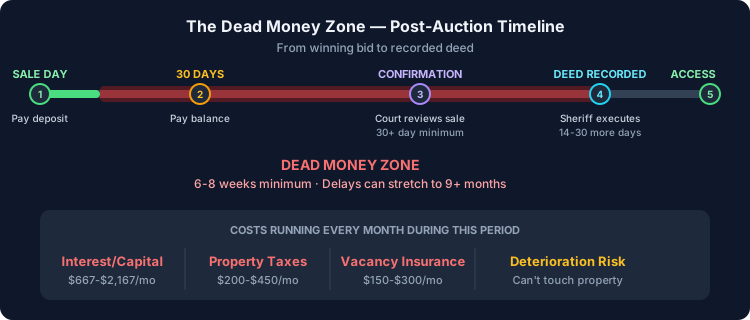
- Sale day. You pay your deposit (a flat dollar amount set by statute, not a percentage) and the remaining balance within 30 days per ORC 2329.281.
- Confirmation period. The plaintiff's attorney files for confirmation of sale with the court. The court reviews the sale, and the former homeowner has the right to redeem the property (pay off the full judgment) until confirmation is filed. This takes a minimum of 30 days per ORC 2329.311.
- Deed recording. After confirmation, the sheriff executes the deed and it gets recorded with the county recorder. Another 14 to 30 days typically.
- You can finally act. Only after you have the recorded deed in hand can you legally access the property, change locks, begin renovation, or secure the building.
Total minimum timeline: roughly six to eight weeks. But delays are common. If the defendant files bankruptcy (even the day before the confirmation hearing), the entire process freezes. We've seen cases drag to nine months. One documented case on BiggerPockets ran 16 months from auction win to possession.
During all of that time, you're paying. Every month. For a property you can't touch.
Five cost categories that stack up during the dead money zone
Most investors think about two numbers: purchase price and renovation budget. The dead money zone is a third bucket of costs that sits between those two, and most people don't know it exists until they're already paying it.
1. Capital costs (opportunity cost or hard money interest)
If you paid cash, your money is locked and earning nothing. If you used hard money lending, you're paying interest from day one.
At 13% annual rate on a $120,000 purchase, that's $1,300 per month in interest. At 10% on $80,000, it's $667 per month. These are real checks you write while the property sits empty and you wait for a piece of paper.
2. Property taxes from sale date
Ohio law makes the buyer responsible for property taxes starting on the sale date, not the deed date. You owe taxes on a property you can't legally enter.
For a typical auction property, expect $200 to $400 per month depending on county and assessed value. And here's the kicker: under HB 186, if the property was receiving a homestead exemption or other reduction, the county auditor can reassess the property at the next tax cycle. That often means a higher tax bill than what the previous owner was paying.
3. Vacant property insurance (or no insurance at all)
This is the cost most investors skip entirely. Standard homeowner policies void after 30 to 60 days of vacancy. Landlord policies have similar exclusions. Sheriff sale properties are vacant by definition.
Vacant property insurance runs $150 to $300 per month, roughly 1.5 to 3 times what standard coverage costs. Carriers that write these policies include Vacant Express, Tower Hill, Markel, and Berkshire Hathaway Homestate.
During the dead money zone, you may not even be able to get a vacancy policy because you don't have the deed yet. Some investors carry no insurance at all during this period. A pipe burst, fire, or vandalism event on an uninsured property can wipe out every dollar of projected profit.
Once renovation starts, you need a different policy: builder's risk insurance, which covers improvements being made. That runs $230 to $460 per month. During active rehab, you need both a vacant property policy and builder's risk, or a vacancy policy with a builder's risk endorsement.
4. Property security and deterioration
You can't board up windows. You can't winterize pipes. You can't change locks. The property sits exactly as it was on auction day, and anything that happens to it during the dead money zone is your problem once the deed arrives.
Copper theft, broken windows, squatter damage, water damage from burst pipes in winter. We've tracked properties that lost $5,000 to $15,000 in value during the deed wait simply from deterioration that the buyer couldn't prevent.
This isn't a line item you can budget precisely, but it's worth padding your renovation estimate by 10% to 20% for properties with long expected deed timelines.
5. Redemption and legal risk
Until the confirmation hearing, the former homeowner can redeem the property by paying off the full judgment. If that happens, you get your purchase price back, but it takes a minimum of three weeks to process the refund (per Summit County's published procedures). Your money was tied up, you paid opportunity cost, and you walk away with nothing to show for it.
Separately, IRS federal tax liens survive the sheriff sale entirely. They are not wiped out. Under 26 USC 7425, the IRS retains a 120-day redemption right after the sale. During those 120 days, the IRS can buy the property from you at the price you paid. You get your money back, but your deal is gone. Always check the case docket for IRS liens before bidding.
Junior liens (second mortgages, mechanic's liens, HOA liens) are extinguished only if those lienholders were properly named as parties in the foreclosure action and served. If a lienholder wasn't served, their lien survives. Check every named defendant on the case docket.
Carrying cost breakdown by purchase price
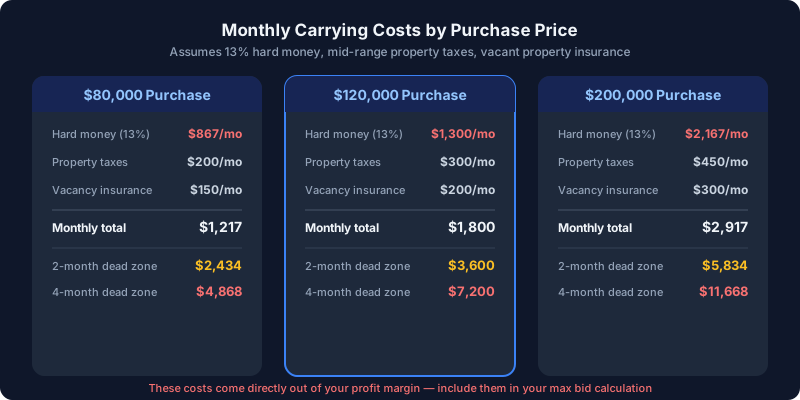
We put together a monthly cost breakdown at three common purchase price levels. These assume 13% hard money, mid-range property taxes, and basic vacant property insurance.
| Cost category | $80,000 purchase | $120,000 purchase | $200,000 purchase |
|---|---|---|---|
| Hard money interest (13%) | $867/mo | $1,300/mo | $2,167/mo |
| Property taxes | $200/mo | $300/mo | $450/mo |
| Vacant property insurance | $150/mo | $200/mo | $300/mo |
| Monthly carrying cost | $1,217/mo | $1,800/mo | $2,917/mo |
| 2-month dead zone total | $2,434 | $3,600 | $5,834 |
| 4-month dead zone total | $4,868 | $7,200 | $11,668 |
If you paid cash instead of hard money, replace the interest line with your opportunity cost, whatever that money would earn invested elsewhere. For most investors, that's 5% to 8% annually, which cuts the top line roughly in half.
Look at the middle column. A two-month dead zone on a $120,000 property costs you $3,600 before you touch a single thing. A four-month delay doubles it to $7,200. That's money that comes directly out of your profit margin, and it needs to be in your max bid calculation.
County-by-county deed timelines
Not every county moves at the same speed. We track data posting frequency across all 88 Ohio counties on our County Recap pages, and counties that process court filings faster tend to post auction results more frequently too.
Based on our tracking and community reports:
Faster counties (6-8 weeks typical):
- Cuyahoga County posts data most frequently. Court processing tends to be faster in larger metro counties with dedicated foreclosure dockets.
- Franklin County runs a high-volume docket with generally predictable timelines.
Mid-range counties (8-12 weeks typical):
- Hamilton County, Lucas County, and Butler County tend to fall in this range, though individual cases can run longer.
Slower or less predictable counties:
- Montgomery County and Summit County have shown longer data gaps in our tracking, which often correlates with slower court processing.
- Rural counties with smaller dockets may process faster on a per-case basis but post results less frequently.
The confirmation timeline per ORC 2329.311 is a minimum, not a guarantee. Bankruptcy filings, contested confirmations, and court backlogs can extend any county's timeline significantly.
How to budget for the dead money zone
Your max bid formula probably looks something like this:
ARV minus renovation costs minus desired profit equals max bid.
It should look like this:
ARV minus renovation costs minus dead zone carrying costs minus desired profit equals max bid.
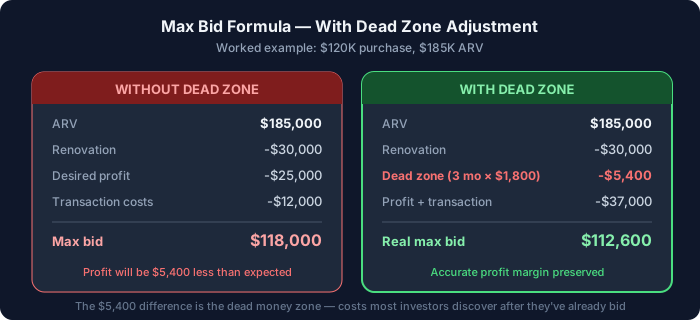
Worked example for a $120,000 purchase with an ARV of $185,000:
- ARV: $185,000
- Renovation: $30,000
- Dead zone costs (3 months at $1,800/mo): $5,400
- Desired profit: $25,000
- Transaction costs (buying + selling): $12,000
- Real max bid: $112,600
Without the dead zone adjustment, you'd have bid up to $118,000 and wondered why your profit was $5,400 thinner than projected.
A few rules we've learned the hard way:
- Budget for a minimum of two months of carrying costs, even in fast counties.
- For properties with bankruptcy-involved defendants or contested titles, budget four to six months.
- Add the dead zone estimate to your renovation contingency, not your purchase price. That way it's visible in your deal analysis as a separate line.
- If you're using hard money, confirm with your lender whether the interest clock starts at funding or at deed recording. Most start at funding.
How AuctionScout's deal scoring accounts for holding costs
When you run a deal analysis on AuctionScout, the investment analysis includes holding period costs in the ROI calculation. It's not just purchase price versus ARV. The system factors in the time gap between acquisition and exit, which includes the dead money zone.
Deal Scoring flags properties where the holding cost exposure is higher, such as properties in counties with longer average confirmation timelines or cases with more defendants (which correlates with contested confirmations).
You can also use the renovation estimator to model different dead zone scenarios. Run the numbers with a two-month hold, then a four-month hold, and see how it changes your projected return. If the deal only works with a six-week deed timeline and zero complications, it's probably not a deal.
Frequently asked questions
Can I access the property before I get the deed?
No. Until the deed is recorded in your name, the prior owner retains legal occupancy rights. Summit County explicitly warns that entering the property before receiving your deed can result in criminal charges. This applies even if the property appears vacant and abandoned.
Do I owe property taxes during the dead money zone?
Yes. Ohio law assigns tax responsibility to the buyer starting on the sale date, not the deed date. You will owe a prorated share of taxes from the sale date forward.
What happens if the former owner redeems the property?
The former homeowner can redeem by paying the full judgment amount any time before the confirmation filing. If that happens, your purchase price is refunded, but the refund takes a minimum of three weeks to process. You don't get reimbursed for taxes paid, insurance, or interest during the wait.
Do IRS liens get wiped out at sheriff sale?
No. IRS federal tax liens survive the sale under 26 USC 7425. The IRS also gets a 120-day redemption period after the sale. During those 120 days, the IRS can purchase the property from you at the price you paid. Always check the case docket for federal tax lien involvement before bidding.
How do deposits work for Ohio sheriff sales?
Deposits are flat dollar tiers set by ORC 2329.211, not percentages. For properties appraised at $10,000 or less, the deposit is $2,000. For $10,001 to $200,000, the deposit is $5,000. Above $200,000, the deposit is $10,000. Franklin County is an exception where the plaintiff's attorney sets the deposit amount.
What's the two-thirds minimum bid rule?
On the first sale, the minimum bid is two-thirds of the sheriff's appraised value per ORC 2329.20. If the property doesn't sell at first sale, a second sale is scheduled within 7 to 30 days under ORC 2329.52, and the second sale has no minimum bid. This is first sale only, not a blanket rule.
Every Ohio sheriff sale has a dead money zone. The question is whether you budget for it or discover it after the fact. Run the carrying cost math before you bid, not after.
Set up deal alerts on AuctionScout and use deal scoring to see holding costs built into every analysis. The 14-day free trial gives you full access, no credit card needed.