
Every Ohio county sheriff's FAQ page says the same thing: "Have your financing in order before you bid." None of them tell you what that actually means.
We looked at the top 20 search results for "ohio sheriff sale financing." Zero Ohio-specific guides. A handful of BiggerPockets threads from 2015-2023 with conflicting advice. Ten county .gov pages that all punt on the details. Nobody maps financing to investor strategy. Nobody explains how Ohio's statutory timeline constrains your options, or what the carrying costs of that timeline actually come to.
This guide does both. If you're bidding on Ohio sheriff sales, or planning to, the financing decision comes before the max bid. Getting it wrong can cost $15,000-$30,000 in unnecessary interest and fees on a single deal.
The myth: "I'll just get a mortgage"
This is the most common assumption new investors bring to sheriff sales. It's wrong.
Conventional lenders, including FHA and VA, will not finance an Ohio sheriff sale property at the time of purchase. The reasons are all structural.
First, there's no interior inspection. Sheriff sale properties are typically sold sight-unseen. You can't enter the property before the sale. Conventional lenders require an interior appraisal. FHA and VA have even stricter property condition standards that can't be verified when nobody can get inside.
Second, the property transfers via sheriff's deed, not a standard warranty deed. Title insurance is available on sheriff sale properties in Ohio (because Ohio uses judicial foreclosure, which gives title companies a court record to work from), but some conventional lenders have internal policies against lending on sheriff's deeds without a quiet title action first.
Third, there's a timeline problem. Conventional mortgage underwriting takes 30-45 days minimum. Ohio's sheriff sale closing timeline doesn't wait for your lender's underwriting department. More on this below.
If your plan for paying for a sheriff sale property is "get a mortgage," you need a different plan.
Ohio's timeline changes everything: the ORC 2329.211 constraint
Ohio's sheriff sale closing process creates a timeline that rules out most conventional financing and constrains the alternatives. You need to understand this before picking a financing path.
Under ORC 2329.211, here's the sequence:
On auction day, you win the bid and pay a deposit. The deposit is a statutory flat amount based on the property's appraised value:
| Appraised value | Required deposit |
|---|---|
| $10,000 or less | $2,000 |
| $10,001 to $200,000 | $5,000 |
| Over $200,000 | $10,000 |
Franklin County is an exception. The plaintiff's attorney sets the deposit amount at their discretion.
Then comes the confirmation period, which takes 2-6 weeks. The court must confirm the sale before the closing clock starts. This isn't automatic. The foreclosing lender, other lienholders, or the homeowner can object. Two weeks in a smooth case, six weeks if there are objections or scheduling delays. Your deposit is locked the entire time and the property sits in limbo.
Once the court confirms, a 30-day closing window opens. You have 30 days to pay the remaining balance. This is when your financing needs to be ready to deploy, not just approved in theory.
Add it up and the total capital-lock period runs six to ten weeks from auction day to closing. Your lender needs to be ready to fund quickly once confirmation comes through, not start underwriting at that point.
Confirmation timing varies meaningfully by county. Larger counties with heavier dockets (Cuyahoga, Franklin, Hamilton) tend to run on the longer end. Smaller counties can confirm in two weeks. Our county recap pages show weekly auction activity by county, which is useful for sanity-checking how active a docket is before you bid there.
The financing decision tree by investor strategy
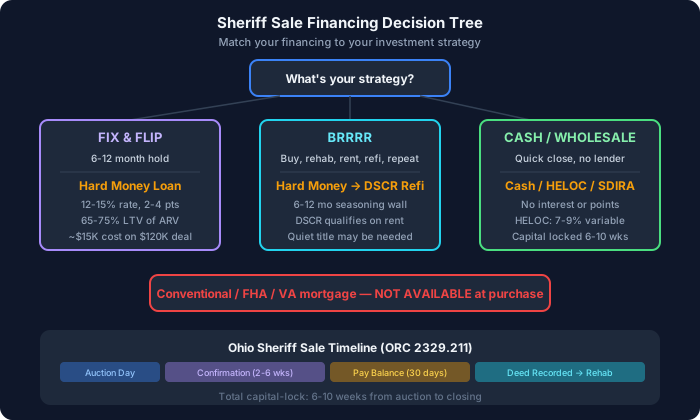
Your financing path should match your investment strategy. Each path comes with specific costs and constraints.
Fix-and-flip: hard money loan
If you're buying to renovate and resell within 6-12 months, hard money is the standard path. These are asset-based loans where the property is the collateral, not your income or credit score. They're built for short-term investment purchases.
Typical Ohio hard money terms:
- Interest rate: 12-15%
- Origination: 2-4 points (each point is 1% of the loan amount)
- Loan-to-value: 65-75% of ARV (after-repair value), so you still need cash for the gap
- Term: 6-12 months
- Non-owner-occupied investment properties only
One thing to watch: the confirmation gap means your hard money timeline doesn't start at auction. It starts when the court confirms the sale, which could be weeks later. Interest doesn't accrue until the loan funds, but your lender needs to be pre-arranged and ready to close within that 30-day window. Some lenders won't fund until the sheriff's deed is actually recorded, which adds more delay. Ask about this upfront.
A real cost example: on a $120,000 purchase with a hard money loan at 13% interest, 3 points origination, and a 9-month hold, you're paying roughly $3,600 in points plus $11,700 in interest. That's $15,300 in financing costs before you've spent a dollar on renovation. If your ARV estimate is off by even 5%, those financing costs eat your margin.
BRRRR (buy, rehab, rent, refinance, repeat): hard money then DSCR refi
The BRRRR strategy uses short-term hard money to acquire and renovate, then refinances into a long-term loan once the property is stabilized and rented. The sheriff sale acquisition starts the same as a flip: hard money.
The difference is the exit. Instead of selling, you refinance into a DSCR (Debt Service Coverage Ratio) loan. DSCR lenders qualify based on the property's rental income relative to the mortgage payment, not your personal income, which is how investors scale past a handful of properties.
The catch is seasoning requirements. Most DSCR lenders require 6-12 months of ownership before they'll refinance. Some measure from the date of purchase (the sheriff's deed), others from the date of recording. Either way, you're carrying hard money interest for the full seasoning period. We'll cover this in detail in the seasoning wall section below.
AuctionScout's Deal Analysis tab compares flip, BRRRR or long-term rental, and short-term rental paths for any Ohio sheriff sale property, so you can see how each financing path changes your actual numbers. Explore it here
Wholesale (post-SB 155): cash or assignment
Wholesaling at sheriff sales is a narrow path. You buy at auction and assign or quickly resell the property to an end buyer for a fee.
Ohio's SB 155, effective March 2, 2026, added disclosure requirements to wholesaling transactions. How SB 155 applies to court-supervised sheriff sales (versus private contracts) is still being worked out, but the safest approach is to assume disclosure requirements apply.
You generally need cash or the ability to close fast and resell before carrying costs stack up. Assignment of bid is possible in some counties. Franklin County explicitly allows it with a purchaser information form and court order. But it's county-specific and requires legal coordination.
For financing: cash on hand, or a very short-term bridge loan. Hard money can work, but the cost structure eats into a wholesale fee that's typically thinner than a flip margin.
Cash investor: SDIRA, HELOC, or reserves
Buying with cash simplifies the sheriff sale process. No lender approval, no funding delays. You bid, deposit, wait for confirmation, pay the balance.
Common cash sources:
Self-directed IRA (SDIRA) lets you use retirement funds to purchase investment real estate. The property must be held in the IRA, not for personal use, and all income and expenses flow through it. You'll need a custodian that handles real estate transactions.
HELOC (Home Equity Line of Credit) lets you borrow against equity in a property you already own. Variable rates, but typically much cheaper than hard money (often 7-9% as of early 2026). You get the speed of cash with the flexibility of a credit line.
Cash reserves are the most straightforward. No interest, no points, no lender coordination. The trade-off is opportunity cost: that capital is locked for six to ten weeks minimum during the confirmation-to-closing process.
The BRRRR seasoning wall: what happens after you buy
If your strategy is BRRRR, the biggest financing surprise comes after the acquisition. You've bought with hard money. You've finished renovations. You've placed a tenant. Now you want to refinance into a long-term loan and pull your capital back out.
This is where the seasoning wall hits.
Most DSCR and conventional lenders require 6-12 months of ownership before they'll refinance based on the current appraised value. Try to refi before the seasoning period ends and the lender uses your purchase price (the sheriff sale bid) as the basis for the loan, not the post-renovation appraised value. That defeats the entire BRRRR.
Some lenders also have stricter policies for sheriff's deeds than for standard warranty deeds. They may require a quiet title action before they'll refinance. In Ohio, a quiet title action typically costs $1,500-$3,000 in legal fees and takes 2-6 months. It's not always necessary. Ohio's judicial foreclosure process gives title companies a court record to work from, and many will insure the title without a quiet title action if the search is clean. But it's a cost and timeline risk to factor in.
A smaller risk worth tracking: after the sale, the county auditor may reassess the property's tax value. If that happens mid-refinance, it can shift the numbers your lender is working with. Not common, but it does happen.
The practical math: on a property you bought at sheriff sale for $80,000 and renovated to an ARV of $160,000, a 12-month seasoning period means you're carrying hard money at 13% for a full year. That's roughly $10,400 in interest on top of the origination points you already paid. The BRRRR still works at those numbers, but only if you built those carrying costs into your original bid.
Three mistakes that cost Ohio sheriff sale investors thousands
1. Assuming a conventional mortgage will work
This one wastes weeks. You talk to a lender, get pre-approved, find a property, win the bid, and then discover your lender won't fund a sheriff sale purchase. Now you're scrambling for hard money during the 30-day closing window, probably accepting worse terms because you're under time pressure. Rushed hard money arrangements often come with higher points (4 instead of 2-3) and higher rates. On a $100,000 purchase, that's an extra $1,000-$2,000 in origination costs alone.
2. Not accounting for the confirmation gap in hard money timelines
Many investors treat the auction date as day one of their project timeline. It isn't. The confirmation gap adds 2-6 weeks of dead time where you can't access the property, but you may already be paying interest if your hard money funded at purchase. If confirmation takes six weeks, that's six weeks of interest at 12-15% before you can start renovation. On a $120,000 loan at 13%, that's about $3,000 for doing nothing.
You can sometimes negotiate the loan to fund at confirmation instead of at auction. Not all lenders offer this, but it's worth asking.
3. Ignoring seasoning requirements before planning the exit
BRRRR investors who don't factor in the 6-12 month seasoning period end up carrying hard money far longer than expected. They assumed they could refi in three months once renovations were done. Instead they're paying 13% for a year. The difference between a 3-month and 12-month carry on a $120,000 loan at 13% is roughly $7,800 in additional interest.
Know your target DSCR lender's seasoning requirements before you bid. Build the full carrying cost into your max bid calculation.
How to calculate true ROI with financing costs baked in
A deal that looks like 25% ROI with cash might be 12% with hard money once you add interest and points. Your financing structure changes your actual return on every deal.
When calculating your max bid for a sheriff sale, these financing costs need to be in the spreadsheet:
- Origination points on the hard money loan (2-4% of loan amount, paid upfront)
- Interest carry for the full expected hold period, including the confirmation gap and any seasoning period
- Closing costs on both the purchase and the exit (sale or refi)
- Quiet title costs if your refi lender requires one ($1,500-$3,000 plus 2-6 months of additional carrying time)
- Opportunity cost of capital locked during the confirmation period
Here's how those stack up on a real deal. A property with an ARV of $180,000 and a sheriff sale bid of $100,000 looks great on paper. Add $4,500 in hard money origination, $15,000 in interest over a 12-month hold, $30,000 in renovation, $8,000 in holding costs (taxes, insurance, utilities), and $10,000 in selling costs. Your actual profit is $12,500 on $104,500 deployed. That's 12% annualized, not the 40%+ the raw spread suggested.
Knowing this before you bid changes what you're willing to pay. It should also change which financing path you pick.
AuctionScout's Deal Analysis tab lets you adjust the assumptions behind each path, not just the bid price. The numbers run across flip, BRRRR or long-term rental, and short-term rental so you can see where the deal actually works. Try it free for 14 days, no credit card required.
Frequently asked questions
Can you get a mortgage on an Ohio sheriff sale property?
No. Conventional, FHA, and VA lenders won't finance sheriff sale properties at the time of purchase. No interior inspection is possible before the sale, property condition can't be verified to meet lending standards, and the sheriff's deed creates title questions some lenders won't accept. You'll need hard money, cash, a HELOC, or a self-directed IRA instead.
How much does hard money cost for an Ohio sheriff sale?
Expect 12-15% annual interest with 2-4 origination points. Loan-to-value ratios run 65-75% of the after-repair value, so you still need cash to cover the gap. Terms are usually 6-12 months. On a $120,000 deal at 13% with 3 points, you're looking at roughly $15,300 in total financing costs over a 9-month hold. Non-owner-occupied investment properties only.
How long do you have to pay for a sheriff sale property in Ohio?
After winning the bid, you pay a deposit (a flat statutory amount of $2,000, $5,000, or $10,000 based on the appraised value per ORC 2329.211). The court then confirms the sale, which takes 2-6 weeks. After confirmation, you have 30 days to pay the remaining balance. Total timeline from auction to closing: roughly six to ten weeks.
Can you refinance after buying a sheriff sale property?
Yes, but not right away. Most DSCR and conventional lenders require a 6-12 month seasoning period before they'll refinance based on current appraised value. Some lenders also require a quiet title action for properties acquired via sheriff's deed, which adds $1,500-$3,000 in legal costs and 2-6 months of time. Factor these into your total financing costs before you bid.
What is a DSCR loan and how does it work for sheriff sale investors?
A DSCR (Debt Service Coverage Ratio) loan qualifies based on the property's rental income relative to the mortgage payment, not your personal income. BRRRR investors use them to refinance after acquiring and renovating a sheriff sale property. The property needs to be stabilized (renovated and rented) with a DSCR typically above 1.0-1.25. Seasoning requirements of 6-12 months apply.