
Updated October 2026 with AuctionScout data through September 2026.
Every Ohio sheriff sale horror story we have ever heard comes back to the same root cause: somebody bid before they had information that cost less than $300 to obtain.
That is not a guess. We have tracked enough post-sale community posts to build a pretty clear pattern. Surviving water bill nobody checked. Code violation lien that lived at the municipal building, not the recorder's office. Sale that got vacated three weeks after the gavel because the docket showed a pending motion to stay. Bid voided because the buyer never filed the tax delinquency affidavit. Each of these wipes out the discount that drew the investor in.
The pre-bid checklist below takes about two hours and costs around $300. Skip any of these five checks and you are gambling with the difference between your winning bid and an average $5,000 to $15,000 surprise. We call this the 40:1 ratio: $300 of preparation against $12,000 of expected pain. It is the best ROI in Ohio real estate, and almost nobody runs the full sequence.
Here is the ohio sheriff sale due diligence checklist we run on every property worth bidding on.
The $300 vs $12,000 equation
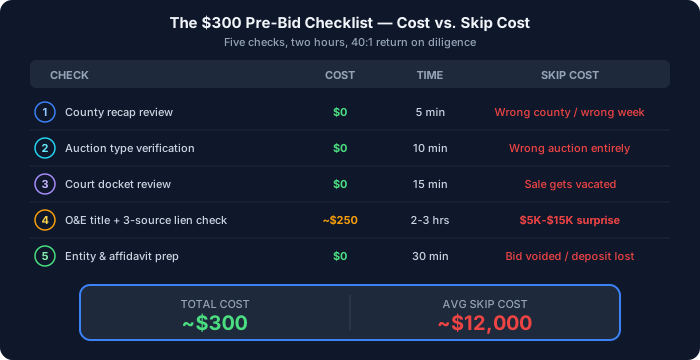
Most investors think of due diligence as something you do during contingency periods, which sheriff sales do not have. That mental model is the problem. You cannot inspect, you cannot finance-contingent your way out, you cannot back away after the gavel without forfeiting your deposit (between $2,000 and $10,000 under ORC 2329.211, depending on appraised value). The court order is binding.
So all due diligence has to happen before bid day. The investors who win consistently treat the pre-bid phase as the actual purchase decision. The auction itself is the easy part.
The math is brutal once you see it laid out. A property that appraises at $100,000, opens at the two-thirds minimum ($66,667 on first sale per ORC 2329.20), sells at $80,000 looks like a $20,000 win. Discover a $9,000 surviving water bill from ORC 743.04, a $3,500 special assessment from ORC 727.25, and a $2,000 municipal code violation that survived because the buyer never thought to call the city, and your $20,000 win is suddenly a $5,500 win after closing costs and lien payoffs. That is if you actually catch the liens before resale rather than during it.
The pre-bid sequence below stops most of this before it starts.
Check 1: County recap (what sold, for how much, how recently)
Cost: $0 to $49 per month. Time: 5 minutes.
Before you look at any specific property, look at the market it is in. A sheriff sale bid that ignores the county's recent sale rate, median discount vs est. market value, and price band is a bid placed in a vacuum.
We publish weekly county recaps for the Ohio counties we track at auctionscout.app/recap/. Here is what to pull from your county's page before you bid:
- Sale rate for the last two to four weeks (and how it compares to the all-time average). Check why before you read anything into a dip. In July 2026, for example, AuctionScout recorded 16 Cuyahoga County lots as postponed and 23 as cancelled before bidding, and a dip driven by pulled lots says nothing about buyer competition.
- Median sold price and the median discount to est. market value. Treat the discount as context, not your margin: est. market value assumes a home in normal condition.
- Number of properties listed vs number sold. Low volume weeks usually mean compressed bid spreads.
- Buyer category breakdown. If the plaintiff is winning most properties back, third-party bidders are getting outbid. That changes your bid strategy.
In Franklin County in Q1 2026, our data shows the median sale went 23.3 percent below est. market value (61 sales with an eligible estimate). Hamilton County posted a deeper median discount (33.8 percent, 23 sales), and AuctionScout recorded 30 Hamilton lots as cancelled and 1 as postponed before the sale. (Figures as of October 2026.)
You do not need to do econometric analysis. You need to know whether your $80,000 bid in your county this month is high, low, or about right. Five minutes on the county recap page answers that.
Check 2: Auction type verification
Cost: $0. Time: 10 minutes.
This sounds embarrassingly basic. It is also one of the most common ways new Ohio investors waste a Tuesday morning and lose a deposit.
Ohio has three different auction types, and they get confused constantly:
Sheriff sale (judicial foreclosure). Court-ordered sale to satisfy a mortgage or judgment. Conducted on the state-mandated RealAuction platform under ORC 2329.153. First sale has a two-thirds-of-appraisal minimum bid (ORC 2329.20). Second sale has no minimum (ORC 2329.52). This is what most investors mean when they say "sheriff sale."
Tax sale (tax lien certificate sale). Sale of the delinquent tax lien itself, not the property. You buy the right to collect the back taxes plus interest. Property owner retains title and right to redeem. Mostly a yield play, not an acquisition play. Different statute, different deposit, different auction calendar.
Tax deed sale / forfeited land sale. When the property is forfeited to the state after years of tax delinquency, it can be sold by the county auditor. Different process again, different timing.
Investors who plan to bid on what they think is a sheriff sale but is actually a tax lien certificate sale show up expecting to buy property and end up buying a piece of paper that pays interest. Investors who plan to bid on what they think is a tax deed sale but is actually a regular sheriff sale show up with the wrong deposit structure.
Two-minute fix: open the county sheriff's auction page and the county treasurer's auction page side by side. Confirm the date, the property, and which auction type it is listed under. Confirm whether it is first sale or second sale, because the two-thirds minimum bid rule applies to first sales only. If you cannot find this on either page, call the office before you put money down.
Check 3: Court docket review
Cost: $0. Time: 15 minutes.
The sale you are about to bid on is the result of a court case. That case is still alive on the docket the morning of the auction. Courts vacate sales for all kinds of reasons: bankruptcy filings, last-minute payment arrangements, motions to stay, technical defects in service.
You can pull the docket from the county Clerk of Courts website. Look at the case associated with the property. Specifically check:
- Pending motions filed in the last 30 days, especially anything labeled "Motion to Stay," "Motion to Vacate," "Motion for Relief from Judgment," or "Suggestion of Bankruptcy."
- Whether the borrower has filed Chapter 7 or Chapter 13 in the last six months. Bankruptcy automatically stays the foreclosure. If the auction proceeds anyway and the stay is later proven valid, the sale is void ab initio (treated as if it never happened).
- Whether the confirmation order from a prior auction was vacated. If this is a second sale because the first sale fell through, you need to know why.
- Whether the plaintiff is the original lender or an assignee. Assignment chain defects sometimes show up here.
An investor can win a bid on Tuesday and learn on Friday that the sale was set aside because a Chapter 13 filing the previous week was not noticed in time. Deposit returned, day wasted, opportunity gone.
Fifteen minutes on the docket prevents this. For a deeper walkthrough, see our docket screening guide.
Check 4: Owner and Encumbrance (O&E) title report and the 3-source check
Cost: $250 (approximate, varies by title company). Time: 3 to 5 business days.
This is the check most investors skip, and it is the single most expensive thing to skip. The O&E report from a title company gives you the recorded title history and recorded liens against the property. That is necessary but not sufficient.
Here is the part that surprises most new bidders: in Ohio, two of the most common surviving lien types are NOT in the county recorder's office. They live in different places entirely. An O&E title report alone will miss them.
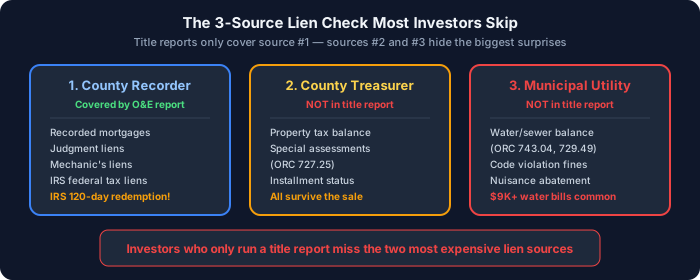
The three sources you actually need to check are:
Source 1: County recorder. This is where the title company looks. Recorded mortgages, recorded judgment liens, recorded mechanic's liens, recorded federal tax liens. Surviving items here include property tax liens under ORC 5721.10 and any junior liens whose holders were not properly served in the foreclosure action. Junior liens of properly-served lienholders are extinguished by the foreclosure decree. Junior liens of un-served or improperly-served holders survive.
Source 2: County treasurer. This is where property tax and most special assessment data actually lives in operational form. Special assessments under ORC 727.25 (street improvements, sidewalks, sewer hookups) survive the sheriff sale. The treasurer will tell you exactly what is owed and whether assessments are paid current. Do not rely on the title report alone for this number.
Source 3: The municipal utility office. This is the source nobody warns you about. Water and sewer liens under ORC 743.04 and ORC 729.49 survive the sheriff sale and they live at the city or village utility billing office, not the county recorder. So do municipal housing code violations, fines, and nuisance abatement charges, which become liens under home rule ordinances and are typically tracked by the city building department or law director.
A property with a $9,000 unpaid water bill will not show that on the title report. The water bill is between the homeowner and the city. The lien attaches by operation of law and survives the sale, but it is invisible to the recorder. You only see it if you call the city's water department and ask, or pull the city's online utility lookup if one exists.
The IRS federal tax lien situation is its own category. Federal tax liens under 26 USC 7425 survive AND give the IRS a 120-day redemption right after the sale, meaning the IRS can step in and take the property from you by paying off your bid plus interest within 120 days. Always check the federal tax lien index, which is part of the county recorder source.
The three-call workflow
For every property worth bidding on, run this sequence:
- Order the O&E title report through a local title company. About $250 and three to five business days.
- Call the county treasurer with the parcel number. Ask: total property taxes owed, any unpaid special assessments, current installment status. Ten minutes.
- Call the municipal utility office for that address. Ask: water and sewer balance owing on the property, any liens filed, any code violation fines outstanding. Fifteen minutes (longer in larger cities where you may need to email).
Title insurance is available on sheriff sale purchases in Ohio (judicial foreclosure produces a marketable title under most standard policies), so the O&E is the foundation for getting a clean policy later. You do not need a quiet title action unless defects show up in the chain.
Check 5: Entity and affidavit prep
Cost: $0 (assuming entity is already formed). Time: 30 minutes.
The least exciting check, and the one that voids the most bids on technicalities. Counties have non-negotiable bidder requirements that must be in place before you raise your hand.
The two most common requirements:
Tax delinquency affidavit. Under ORC 2329.66 and various county local rules, bidders must certify under oath that they are not delinquent on Ohio property taxes. If you bid in an LLC, the LLC and often its members must be current. Counties require this affidavit filed in advance or signed at registration. Show up without it and you cannot bid.
Entity registration and authorization. If bidding through an LLC, the entity must be in good standing with the Ohio Secretary of State (check on file with the SOS website, free), and you must have written authorization to bid on the entity's behalf. Some counties require the LLC's Articles of Organization or Operating Agreement on file.
Deposit method. Most counties require cashier's check or certified funds. RealAuction online deposits via wire or ACH have their own pre-bid deadlines, usually 24 to 48 hours before the sale. Personal check is not acceptable in most counties.
The fix is a one-time setup, then re-verify before every sale:
- Verify LLC is in good standing on the Ohio SOS website.
- Print or pre-load the county's tax delinquency affidavit and any required bidder forms.
- Get a cashier's check for the deposit tier matching the property's appraised value (under ORC 2329.211: $2,000 for properties appraised at $10,000 or less, $5,000 for $10,001 to $200,000, $10,000 for over $200,000, with Franklin County as an exception where plaintiff's attorney sets the deposit).
- For online sales via RealAuction, confirm your deposit is posted and approved before the deposit cutoff.
Thirty minutes the day before, fifteen the morning of. That is the entire entity prep workflow.
Common questions
Do I have to do all five checks on every property?
For property #1 ever, yes. After you have done it a few times, checks 1, 2, 3, and 5 take less than 45 minutes combined and become muscle memory. The O&E (check 4) is the only one that costs real money, and it is also the one that catches the biggest financial surprises, so it is the one you should be most disciplined about not skipping.
What if my budget will not cover a $250 title report on a $40,000 property?
This is where the discipline question lives. If you cannot afford $250 of pre-bid investigation, you cannot afford the $9,000 surviving water bill either. Many investors run a "shortlist screen" first using checks 1, 2, 3, and 5 to identify the two or three properties worth ordering an O&E on, then order title reports only on those. That cuts cost without cutting protection.
Are the lien rules the same in every Ohio county?
The statutory survivors (property tax under ORC 5721.10, special assessments under ORC 727.25, water and sewer under ORC 743.04 and 729.49, IRS liens under 26 USC 7425) apply statewide. Municipal code violation rules vary by city home rule charter. Always check with the specific municipality where the property is located, especially in larger cities like Cleveland, Columbus, Cincinnati, Dayton, Toledo, and Akron.
What if the property is in a smaller municipality? Is there still a utility office to call?
Yes. Even small villages have a water clerk, usually at the village hall. In townships served by county or regional water authorities, the authority itself is the source. The principle is the same: water and sewer balances live with the entity that bills for water and sewer, not with the county recorder.
Can I use the title insurance commitment instead of an O&E report?
In some cases yes, if you can get a commitment turned around in time. The commitment will identify recorded liens and exceptions to coverage. It still will not show you water and sewer or code violations, because those are off-record. You still need to make the calls.
Start with check 1
The first check costs nothing and takes five minutes. Pull up your county at auctionscout.app/recap/, see what sold last week, see what is coming up next week. Set up email alerts for the counties you bid in. Takes 30 seconds. Then run the remaining four checks on any property worth bidding on.
That is the entire pre-bid workflow. Two hours, $300, and the surprises stop being surprises.