
Most Ohio sheriff sale investors analyze properties one at a time. They pull comps, estimate repairs, calculate ARV, and then decide whether to bid. That's fine for the final decision on a specific property, and the bid formula is where that decision belongs. But it skips a more basic question: should you even be looking at this county's docket this week?
We built county recap pages that answer that question in two numbers. Sale rate and discount. Together, they tell you whether a county's auction environment favors bidders or whether competition has squeezed the margins dry. Once you learn to read them, you can screen an entire county in under 60 seconds every Monday morning, then go deeper with the full county-selection guide when a market looks worth committing to.
This guide teaches you the framework, walks through real examples, and shows you how to build it into a weekly routine.
Prerequisites
Before this framework is useful, you need:
- A basic understanding of Ohio sheriff sales (you know what the docket is, you've looked at auction listings before)
- Access to county-level auction data. We publish weekly recaps for Ohio counties at auctionscout.app/recap/, which is what this guide references. You could build your own spreadsheet from county records, but it would take hours per week.
- Willingness to look at county-level trends before diving into individual properties. If you're the type who picks a property first and worries about market conditions later, this framework will feel backwards. That's intentional.
The two numbers: sale rate and discount
Every week, a county's sheriff sale docket has some number of properties listed. Some sell. Some don't (postponed, cancelled, no bidders). The ratio of sold to listed is the sale rate.
Of the properties that do sell, they sell at some percentage below appraised value. That gap is the average discount.
That's it. Two numbers.
Sale rate tells you how much competition exists. A 96% sale rate means almost everything is selling. Lots of bidders showing up, lots of demand. A 50% sale rate means half the docket went unsold. Fewer bidders, less pressure.
Average discount tells you what margins look like. A 9% discount means properties are selling at 91% of appraised value. Thin margins. A 39% discount means properties are selling at 61% of appraised value. Wide margins, significant equity on day one.
The framework: four quadrants
Combine the two numbers and you get four scenarios:

High sale rate + low discount (e.g., 96% / 9%): Competition is intense. Almost everything sells, and it sells close to full value. This is a county where bidders are fighting over properties and driving prices up. Unless you have a specific informational edge on a property, skip this week or tighten your max bid significantly.
Low sale rate + high discount (e.g., 50% / 39%): Opportunity window. Half the docket isn't selling, and what does sell goes at a deep discount. Fewer bidders, less competition, wider margins. This is where you want to be spending your time and research hours.
High sale rate + high discount: Unusual but it happens. Lots of properties selling at big discounts. Could signal a wave of distressed inventory hitting the market at once (think: large bank releasing a batch of REO). Worth investigating, but verify the data isn't skewed by one or two outlier sales.
Low sale rate + low discount: Properties aren't selling, but the ones that do sell are still priced high. This often means unrealistic appraisals or minimum bids that are too close to market value. Bidders are sitting it out because the math doesn't work. Not much to do here.
Real example: Cuyahoga vs. Franklin (April 2026)
Real numbers make this concrete.
Cuyahoga County the week of April 13: 73 properties listed, 70 sold. That's a 96% sale rate. Average discount: 9%.
Translation: almost every property sold, and they sold close to appraised value. If you were bidding in Cuyahoga that week, you were fighting 69 other successful bidders for scraps of margin. Average price was $71,163 with only $6,400 in average equity at purchase. After closing costs, holding costs, and any repairs, you're working with razor-thin numbers.
Franklin County the same week: 16 properties listed, 8 sold. That's a 50% sale rate. Average discount: 39%. Average price: $275,037.
Translation: half the docket went unsold, and the eight that did sell went at 39% below appraised value. That's roughly $107,000 in average gross equity per deal. Fewer bidders showed up. Less competition on each property. The tradeoff is lower volume (only eight opportunities that week), but the math on each one is dramatically better.
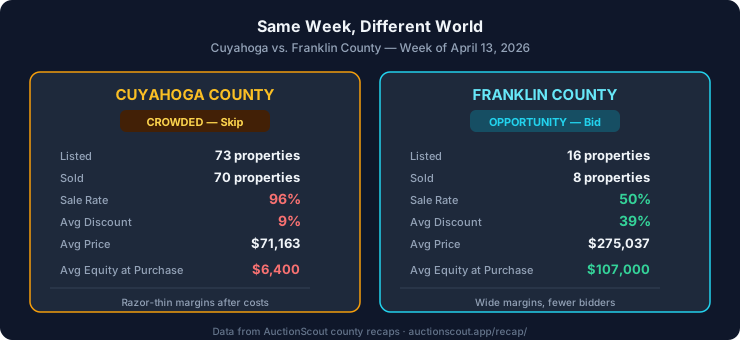
Same state, same week, completely different bidding environments.
How to run this screen every Monday
The whole thing takes about 60 seconds per county once you've done it a few times.
Step 1: Pick your watchlist counties. Most investors focus on 3-5 counties within driving distance. You don't need to monitor all 88. Pick the ones where you'd actually bid and do rehab work.
Step 2: Check the recap page Monday morning. County recap data typically refreshes over the weekend after the prior week's sales finalize. Monday morning gives you the freshest read on what happened.
Step 3: Read the two numbers. Sale rate and average discount. That's all you need for the initial screen.
Step 4: Apply the quadrant logic.
- Sale rate above 80% AND discount below 15%? Competition is hot. Either skip this county this week or only bid on properties where you have a specific edge (you've driven by it, you know the neighborhood, you have a buyer lined up).
- Sale rate below 60% AND discount above 25%? Opportunity territory. Spend your research time here. Pull properties from the docket, run your analysis, prepare bids.
- Something in between? Use your judgment. The framework gives you a quick filter, not a rigid rule.
Step 5: Allocate your research time accordingly. If you have 10 hours this week for deal analysis, spend them on the county that passed your screen, not the one where margins are compressed.
The Monday ritual in practice
We track this across every county in Ohio. Some investors have turned this into a literal Monday morning ritual: coffee, recap pages, 60-second screen, then decide where to focus for the week.
This doesn't replace property-level analysis. You still need to run comps, estimate repairs, and calculate your max bid on individual properties. The county screen tells you where to aim that effort so you don't waste 10 hours analyzing properties in a county where the margins disappeared three weeks ago.
Think of it like checking the weather before deciding which job site to visit. You're not making the final decision based on weather alone, but you'd be dumb to ignore it.
Common mistakes
Mistake 1: Looking at only one week's data. A single week can be an outlier. If a county normally runs 50% sale rate and one week hits 90%, check whether a single large seller dumped inventory. Look at the 12-week trend, not just the latest number.
Mistake 2: Treating all properties as equal within a county. The average discount includes everything from vacant land to occupied single-family homes. If the average discount is 39% but it's being pulled up by three condemned properties nobody wanted, the actual margins on livable homes might be thinner. Use the county screen to decide where to look, then do property-level diligence.
Mistake 3: Ignoring volume. Lucas County had a 100% sale rate and 24% discount one week in April. Sounds great. But only two properties were listed. That's not a trend, that's a coin flip. Counties with fewer than five sales in a week don't produce reliable signals.
Mistake 4: Chasing last week's winner. If Franklin County had a great week, every investor reading the same data will pile in next week. The best use of this framework is identifying consistent multi-week patterns, not chasing single-week spikes.
Mistake 5: Forgetting that sale type matters. Tax foreclosure and mortgage foreclosure sales behave differently. A county's overall numbers blend both. If possible, filter by sale type. Tax foreclosures often have lower sale rates (smaller bidder pool, especially since the affidavit rule kicked in April 2025).
FAQ
Q: Where do I find sale rate and discount data for Ohio counties?
We publish weekly recap pages for Ohio counties at auctionscout.app/recap/. Each page shows listed, sold, sale rate, average price, average discount, and 12-week trend charts. The data updates weekly after sales finalize.
Q: What sale rate and discount thresholds should I use?
There's no universal answer. It depends on your strategy. Flippers with tight margins might skip anything above 70% sale rate. Buy-and-hold investors with longer time horizons might tolerate higher sale rates if the discount still exceeds 20%. Start with the thresholds in Step 4 above, then adjust based on what works for your deal flow.
Q: Does this work for counties outside the top five?
Yes, but the signal gets noisier with low volume. Counties that only run 2-3 sales per week won't give you reliable trend data. For small-volume counties, look at monthly or rolling 4-week averages instead of individual weeks.
Q: How far back should I look at trends?
We show 12-week charts on each county recap page. That's enough to spot whether current conditions are normal or an outlier. If a county has been running 40% sale rates for eight straight weeks and suddenly spikes to 85%, something changed (new bidders entering, institutional buyer, etc.). The 12-week view tells you whether you're looking at the norm or the exception.
Q: Can I use this framework for counties in other states?
The logic applies anywhere you have sale rate and discount data. The specific numbers we cite are Ohio sheriff sale data, but "competition gauge + margin gauge = bid/skip decision" works in any auction environment. The challenge is getting consistent weekly data outside Ohio.
Put it to work
Open your county recap pages next Monday morning. Check the two numbers. Decide where to spend your week. It's a 60-second investment that can save you hours of research in the wrong county.
If you're not tracking county-level data yet, start your free trial at auctionscout.app. We update recap pages weekly for Ohio counties with sale rate, discount, pricing trends, and 12-week charts. Pick your watchlist counties and build the Monday ritual into your process.