
You won a sheriff sale in Shaker Heights. Good price, solid comps, rehab budget dialed in. Then you get a letter from the city: before you can do anything with this property, you need a Point-of-Sale inspection. The inspector finds 14 violations. Exterior paint, gutters, a cracked sidewalk, two electrical panels that aren't up to code. The city gives you 90 days to fix everything. Your repair estimate just jumped $6,000, and your timeline just got 30 days longer. Checking the municipality is one more item for the pre-bid checklist.
This happens constantly in Northeast Ohio. And most auction investors don't see it coming, because it is not the kind of cost a standard hidden-cost budget captures.
Over 30 Ohio municipalities require a Point-of-Sale (POS) inspection when property changes hands. That includes sheriff sale transfers. The city doesn't care that you bought at a foreclosure auction. You still owe them compliance, on their timeline, with their list of required repairs.
We track sheriff sale data across Ohio at AuctionScout, and this is one of the most common blind spots we see in investor underwriting. So let's fix that.
What is a Point-of-Sale inspection?
A POS inspection is a municipal requirement that the property meet certain code standards before (or shortly after) ownership transfers. The city sends an inspector to evaluate the exterior and, in many cases, the interior of the property. They produce a report listing every code violation. You then have a set deadline to complete all repairs and obtain a compliance certificate.
For traditional home sales, the seller usually handles this before closing. But at a sheriff sale, there is no seller cooperating with you. The property transfers through a court order. Which means the POS obligation lands squarely on you, the buyer, after you've already paid.
You can't inspect the interior before the auction. You can't negotiate repairs. You can't back out if the violation list is ugly. You just have to deal with it.
Which Ohio cities enforce POS inspections on sheriff sales?
This is the part that catches investors off guard: there's no master list. Every municipality passes its own ordinance. The requirements, fees, deadlines, and enforcement vary city by city. Here's a partial list of municipalities in Northeast Ohio with active POS ordinances:
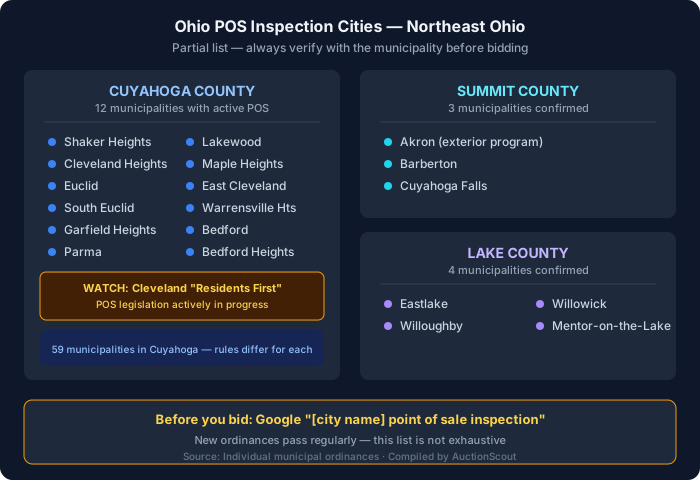
Cuyahoga County (check individual cities on our Cuyahoga County recap page):
- Shaker Heights
- Cleveland Heights
- Euclid
- South Euclid
- Garfield Heights
- Parma
- Lakewood
- Maple Heights
- East Cleveland
- Warrensville Heights
- Bedford
- Bedford Heights
Summit County (see Summit County data):
- Akron (exterior inspection program)
- Barberton
- Cuyahoga Falls
Lake County (see Lake County data):
- Eastlake
- Willoughby
- Willowick
- Mentor-on-the-Lake
This is not exhaustive. New ordinances get passed regularly, and some cities enforce them more aggressively than others. The critical habit: before you bid on any Ohio sheriff sale property, Google "[city name] point of sale inspection." Takes 10 seconds. Could save you thousands.
What Cleveland investors need to know right now
Cleveland proper does not currently have a POS inspection requirement. But the city is actively working on legislation (referred to as "Residents First") that would create one. If you're buying in Cleveland today, you face different rules than someone buying in Cleveland Heights or Lakewood, just a few miles away.
Keep an eye on this. If Cleveland passes a POS ordinance, it will affect the largest volume of sheriff sale properties in the county overnight.
What does a POS inspection actually cost?
The inspection fee itself is usually minor, $50 to $200 depending on the municipality. That's not the problem.
The problem is what the inspector finds. POS inspections are code compliance reviews, and on a distressed property headed through foreclosure, the violation list tends to be long.
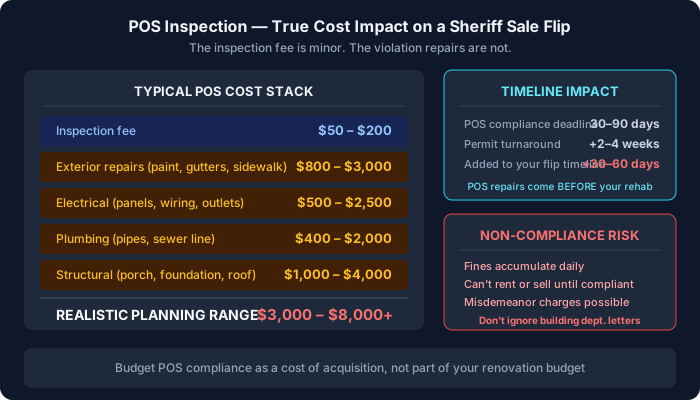
Expect peeling paint, damaged siding, broken gutters, cracked sidewalks. Foundation cracks, porch rot, roof damage. Non-compliant plumbing, galvanized pipes, sewer line problems. Outdated electrical panels, ungrounded outlets, exposed wiring. Missing handrails, broken windows, dead smoke detectors. On a foreclosure property, it's usually not one or two of these. It's most of them.
For a typical distressed property, POS-mandated repairs run $2,000 to $10,000 or more. We use $3,000 to $8,000 as a realistic planning range for most sheriff sale properties in POS cities. Properties with years of deferred maintenance can blow past that.
The kicker: you're committing to these repairs before you've even started your planned renovation. The POS repairs come first. They're mandatory. Your cosmetic rehab and value-add work comes after.
The timeline pressure
Most POS ordinances give the buyer 30 to 90 days after transfer to complete all required repairs and get the compliance certificate. Some cities are stricter than others.
Extensions are possible in some municipalities if you can show progress, but they're not guaranteed. And here's where the math gets ugly: if you planned a 90-day flip and the city gives you 60 days for POS compliance, you're really looking at 120 to 150 days total. That's a different carrying cost calculation entirely.
It gets worse if POS repairs need permits. Electrical, plumbing, structural work all require permits in most cities, and you're waiting on the permit office before you can even start. In some municipalities, permit turnaround alone adds two to four weeks.
Build this into your numbers before you bid. Not after.
Criminal penalties: yes, really
Several Ohio municipalities classify POS non-compliance as a misdemeanor. Read that again. That means the buyer (not just the defaulting previous owner) can face fines or criminal enforcement action if the inspection certificate isn't obtained within the required timeframe.
The odds of prosecution are low for investors making good-faith efforts to comply. But the liability is real. If you ignore the POS requirement, let the deadline pass, and the city decides to enforce, you've got a legal problem on top of your rehab project.
Don't ignore the letters from the building department.
How to screen for POS requirements before you bid
This takes about five minutes per property. It could save you $5,000 to $8,000.
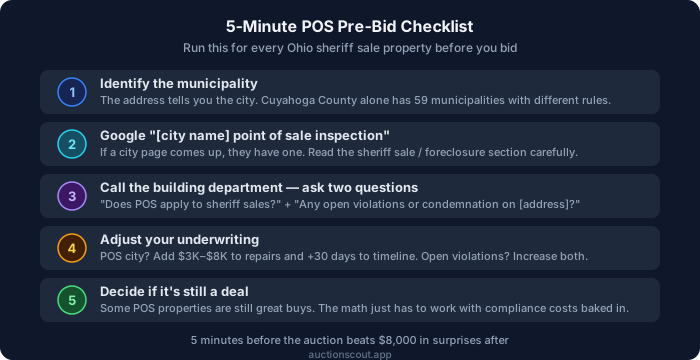
Step 1: Identify the municipality
The property address tells you the city or village. Don't assume the county tells you everything. Cuyahoga County alone contains 59 municipalities, and their POS rules are all different.
Step 2: Google "[city name] point of sale inspection"
Seriously. That's the move. Most cities with POS ordinances have a dedicated page on their municipal website explaining the requirements, fees, and process. If nothing comes up, the city likely doesn't have one. If a page does come up, read it carefully, especially the sections on foreclosure and sheriff sale transfers.
Step 3: Call the building department
For any property in a POS city, call the municipal building department before the auction and ask two questions:
- "Does your POS ordinance apply to sheriff sale transfers?"
- "Are there any open code violations or condemnation orders on [property address]?"
That second question matters more than the first. Open code violations certified to the tax duplicate survive the sheriff sale. They transfer to you. If there's an active condemnation proceeding, you could be buying a property the city wants demolished.
Step 4: Adjust your underwriting
If the city has a POS requirement, add $3,000 to $8,000 to your repair budget and 30 days to your timeline. That's the conservative play. If the building department tells you there are existing open violations, increase both numbers.
Step 5: Decide if it's still a deal
Some properties in POS cities are still excellent buys. The math just has to work with the additional compliance costs baked in. Other investors skip POS cities entirely because they don't want the hassle. That's a valid strategy too.
The worst outcome is not knowing about the POS requirement until after you've won the auction and paid your deposit.
Open code violations: the POS inspection's meaner cousin
Even in cities without a formal POS ordinance, open code violations can transfer to the new owner through a sheriff sale.
When a city issues a code violation against a property and the owner doesn't fix it, the city can certify the violation costs to the county tax duplicate. At that point, it becomes a lien on the property. That lien survives the sheriff sale, just like property taxes and special assessments.
So even if you're buying in a city without POS requirements, you still need to check for open violations. The process is the same: call the building department and ask.
We've seen investors buy properties with $15,000 or more in certified code violation liens they didn't know about. The lien information is sometimes available through the county auditor's website, but not always. A phone call to the city is the most reliable check.
Common mistakes investors make with POS requirements
The biggest one: assuming the county handles everything. Counties run the sheriff sale. Municipalities enforce POS ordinances. These are separate government bodies with separate rules, and the sheriff's office will not warn you about city-level POS requirements.
Related: confusing the city with the county. Cleveland Heights is not Cleveland. It's a separate city with its own POS ordinance. Same with South Euclid, East Cleveland, and a dozen other municipalities that sound like they're part of a larger city. They're not.
Another common mistake is budgeting POS repairs as part of your rehab. POS repairs are mandatory and time-bound. Your planned renovation is optional (from the city's perspective, anyway). Keep them separate in your numbers. POS compliance is a cost of acquisition, not a renovation choice.
Then there's ignoring the timeline. Missing the POS compliance deadline doesn't just mean a fine. In some cities, it means the property can't be rented or resold until you comply. That turns into a carrying cost problem fast.
And finally, skipping the pre-auction phone call. Five minutes with the building department can surface open violations, pending demolition orders, or compliance requirements that change the deal entirely. No shortcut exists for this step.
FAQ
Do POS inspections apply to all sheriff sales in Ohio?
No. POS inspections are municipal ordinances, not state law. They only apply in cities and villages that have passed their own POS ordinance. Many Ohio municipalities don't have one. The requirement depends entirely on which city the property sits in.
Can I get a POS inspection done before the auction?
In most cases, no. The POS inspection is triggered by the transfer of ownership, and you can't schedule it until you're the buyer of record. Some cities allow a pre-sale inspection if you can show you're a prospective buyer, but that's rare. You won't know the full violation list until after you've already won and paid.
What happens if I don't get the POS certificate?
Consequences vary by city. At minimum, you'll face fines. Some cities won't let you rent or sell the property until you comply. In the more aggressive municipalities, non-compliance is a misdemeanor with criminal penalties. The city can also keep adding violation citations, which compounds your costs.
Are POS repair costs tax deductible?
Consult your tax professional, but generally, POS-mandated repairs on an investment property are treated as capital improvements or repair expenses depending on the nature of the work. They're part of your cost basis or deductible against rental income, depending on your investment strategy and how you structure the expense. This is not tax advice. Talk to your CPA.
Does AuctionScout show which properties are in POS cities?
We track auction listings across Ohio counties, and our county recap pages help you see what's happening in each county. While property listings show the municipality, the POS lookup is still a manual step you should do for each city. The Google search and building department phone call takes five minutes and there's no substitute for it.
Make it part of your pre-bid routine
The one-screen POS check belongs in every Ohio investor's due diligence workflow, right alongside the title search, tax lien check, and drive-by inspection. It's not complicated. It just needs to happen before you bid, not after.
If you're working Cuyahoga County, Summit County, or Lake County auctions, this is especially critical. The density of POS cities in these counties means you'll hit one on nearly every auction calendar.
Set up alerts on AuctionScout for the counties you're targeting, then run the POS check on every property that catches your eye. Takes 30 seconds to search, five minutes to call the building department, and it could keep $3,000 to $8,000 from blowing up your rehab budget.