
The most common BiggerPockets advice about LLCs will literally prevent you from bidding at an Ohio sheriff sale.
Form a Wyoming LLC for privacy. Hold property in a Delaware LLC for asset protection. You've heard this advice a hundred times. It's not wrong for buy-and-hold investors who close through escrow on the open market. It is dangerously wrong if you're about to register for an Ohio sheriff sale auction next Tuesday morning, because the Ohio sheriff sale LLC bidding requirements under ORC § 2329.154 don't care about Cheyenne or Wilmington. Your entity needs active status with the Ohio Secretary of State. If it doesn't have that, your registration gets rejected, or worse, your winning bid gets challenged after the fact.
We've watched investors learn this lesson the expensive way. So before you wire a $5,000 deposit and start clicking on RealAuction listings, pick the right entity. This guide walks through the statute, the three bidding options that actually exist (most investors only know about two), the post-sale quitclaim trap, and the county-by-county wrinkles that catch first-timers off guard.
This guide is for informational purposes only and is not legal advice. Consult an Ohio real estate attorney before making entity or bidding decisions.
The trap nobody warns you about: foreign LLCs
Here's the scenario we see most often. An investor reads enough investing books to know "always hold property in an LLC." They form a Wyoming LLC because Wyoming has anonymity protections and low filing fees. They drive a few neighborhoods in Cuyahoga County, find a property they like, and try to register on RealAuction.
Registration goes through. They figure they are fine.
Then they win the bid. Then the deed prep starts. Then someone asks for a certificate of good standing from the Ohio Secretary of State. And the answer is: there is no such certificate, because the LLC was never registered in Ohio.
ORC § 2329.154 is explicit. An entity bidding at an Ohio sheriff sale must provide its legal name, state of formation, date of formation, mailing address, designated contact person, payment information, and (this is the part everyone skips) active status with the office of the Ohio Secretary of State. For a domestic Ohio LLC, that means filed Articles of Organization plus current biennial filings. For an out-of-state LLC, it means filing the foreign LLC registration with the Ohio Secretary of State, paying the filing fee (around $99), and maintaining a statutory agent with an Ohio address.
So your Wyoming LLC needs to be a Wyoming LLC AND a registered Ohio foreign entity before you can lawfully bid. Both states. Both sets of fees. Both sets of annual or biennial filings.
Skip this step and the cleanest outcome is your bid gets invalidated and your deposit gets returned (cleanest because nobody had to litigate it). The messier version is the deed gets recorded to a non-existent-in-Ohio entity and a competitor or junior lienholder challenges the sale on standing grounds. We haven't seen that happen often. We have seen it threatened, which is enough to delay closings and cost legal fees you didn't budget.
ORC § 2329.154 in plain English
The statute splits bidders into two registration tracks: individuals and entities.
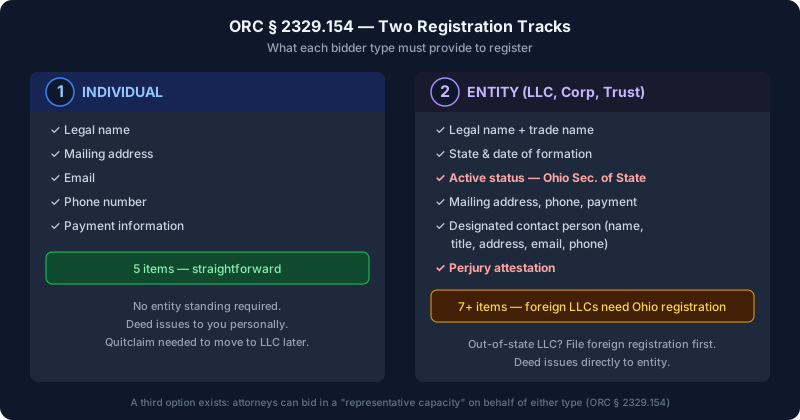
Individuals provide: legal name, mailing address, email, phone, payment information.
Entities provide: legal name, trade name (if it operates under one), state and date of formation, active status with the Ohio Secretary of State, mailing address, phone, payment information, AND a designated contact person with their own name, title, address, email, and phone number. Plus a perjury attestation that everything is accurate.
That last point matters. The contact person signs under penalty of perjury. So if you list yourself as the contact for an LLC you can't demonstrate is in good standing, you're not just risking a registration rejection. You're signing a statement that may be false.
There's a third category, and almost no investor content covers it. ORC § 2329.154 also lets attorneys or law firms register and bid in a "representative capacity" on behalf of a party. So technically you have three options: bid as yourself, bid as your entity, or have your attorney bid for you. We'll get to whether any of those make sense in a minute.
Your three bidding options (and the tradeoff with each)
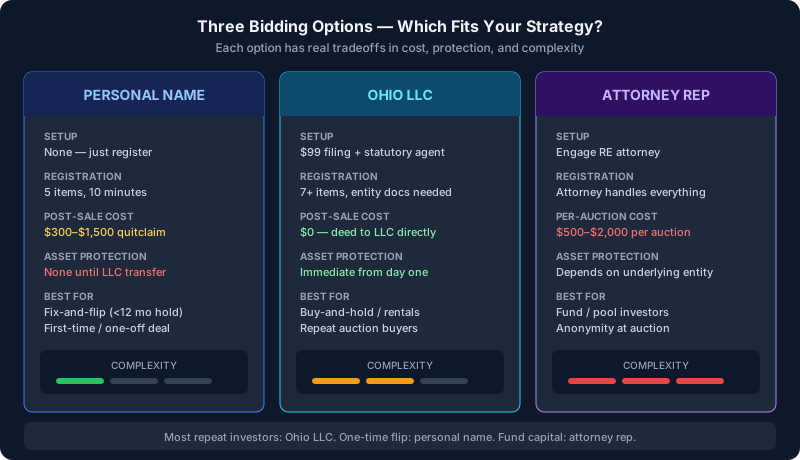
Option 1: Bid in your personal name
Simplest registration. You hand over name, address, email, phone, and a credit card or wire confirmation. The deposit sits with the sheriff. You bid.
Win, and the sheriff's deed gets issued to you personally. Then you decide what to do.
Most investors who buy in personal name plan to deed the property into an LLC after closing using a quitclaim deed. This works. It also costs you. We've seen the all-in cost run $300 to $1,500 depending on the county (recording fees, transfer tax exposure if your county imposes it on intra-family transfers, attorney fees if you don't draft the deed yourself, and a separate title insurance endorsement to confirm coverage carries through to the LLC). Some title companies won't extend the original sheriff's deed coverage to a subsequent LLC owner without underwriting the transfer separately, which adds a few hundred dollars and sometimes a delay.
Personal name bidding makes the most sense if (a) you're doing a fix-and-flip and the property will be sold within 12 months anyway, or (b) you haven't formed an entity yet and you found a deal you can't pass up.
Option 2: Bid in your Ohio LLC's name
Straightforward if you plan to hold or rent the property. The deed gets issued directly to the LLC. No quitclaim, no transfer tax exposure, no title insurance gymnastics later. The asset protection clock starts the day the sheriff's deed is recorded.
The catch is the registration overhead we already covered. Your LLC needs to exist, be in good standing with the Ohio Secretary of State, have a designated contact person on file, and have its payment method ready. More paperwork than personal registration, and meaningfully more if you're coming from out of state.
Option 3: Have an attorney bid in a representative capacity
This is the option nobody talks about. Under ORC § 2329.154, an attorney or law firm can register as a representative bidder on behalf of a party. The party can be a person or an entity.
When does this make sense? A few scenarios we've seen:
- You want anonymity at the auction itself. The attorney shows up (or logs in) and bids. Other bidders don't see your name on the bid sheet.
- You're bidding on behalf of a private money pool. The attorney represents the lender or fund without you having to register the underlying entity for every auction in every county.
- You're out of state and can't make it for the in-person component. Although RealAuction has rolled out across Ohio counties, some county-specific procedures (like deposit handling or post-sale paperwork) still happen in person. An attorney handles those for you.
The cost is real. Expect $500 to $2,000 per auction depending on the relationship and the property value. For most investors, this is overkill. For investors deploying capital from a fund or wanting to keep their name off public bid sheets, it is the only clean path.
Pop quiz: how do deposits even work?
A small detour because we get this question constantly and it intersects with entity choice.
Ohio sheriff sale deposits are statutory and tiered by appraised value, not by a percentage of your bid:
| Appraised Value | Deposit Required |
|---|---|
| $10,000 or less | $2,000 |
| $10,001 to $200,000 | $5,000 |
| Above $200,000 | $10,000 |
That's set by ORC 2329.211. Franklin County is the exception. The plaintiff's attorney sets the deposit at their discretion there, so check the case docket before the auction.
The deposit comes from the bidder's account, which means whoever registered. If your LLC registered, the deposit funds need to come from the LLC's account or be clearly traceable to it. We've seen counties reject wires that came from a personal account when the bidder was an LLC. Not all of them. But it happens often enough that you should fund the LLC's bank account before auction day.
(And yes, the two-thirds minimum bid rule only applies to the first sale. If a property goes to a second sale within 7 to 30 days under ORC 2329.52, there's no minimum. So if you've been waiting to bid on a property that no-saled the first time, the math just changed.)
The post-sale quitclaim trap nobody priced in
Let's go deeper on the personal-to-LLC quitclaim path because this is where the budget surprises live.
Say you bid in your personal name on an $80,000 property. You win at $52,000. Sheriff's deed issues to John Q. Investor. Now you want it in your LLC. Here's what we've actually seen go on the bill:
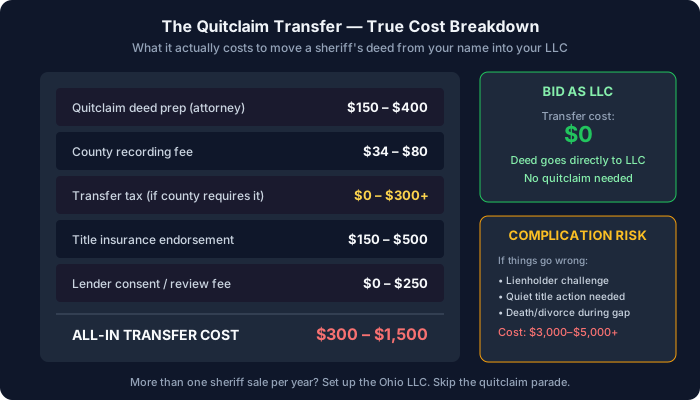
- Quitclaim deed prep: $150 to $400 if an attorney drafts it. Free if you draft it yourself, but title insurance underwriters look at self-drafted deeds harder.
- County recording fee: $34 to $80 depending on the county and page count.
- Transfer tax: Most Ohio counties exempt transfers from an individual to a wholly-owned LLC, but a handful (we've seen this in Hamilton, occasionally) require the conveyance fee even on the intra-party transfer. Check the local rules.
- Title insurance endorsement: $150 to $500 to extend the original owner's policy to the new LLC. Some companies require a fresh search.
- Lender consent: If you financed the auction purchase with hard money, your lender almost certainly has a "no transfer without consent" clause. Getting that consent costs nothing or costs a $250 review fee depending on the lender.
All in: $300 to $1,500 to do what you could have done at zero incremental cost by bidding through the LLC in the first place. And that assumes nothing weird. The "weird" cases, a junior lienholder discovering the transfer and trying to attach, a title insurer requiring a quiet title action, a divorce or a death between the auction and the quitclaim that suddenly makes the transfer messy, those push the bill to four figures fast.
The math is simple. If you're doing more than one Ohio sheriff sale a year, set up the Ohio LLC and bid through it. Skip the quitclaim parade.
Liability is the real reason, not anonymity
Most investors talk about LLCs in terms of privacy. Wrong frame for sheriff sale properties.
Privacy at the auction itself is mostly an illusion. The deed gets recorded. Recordings are public. If somebody wants to know who bought 1234 Elm Street at the Cuyahoga sheriff sale, they can find out in 20 minutes. The Wyoming-LLC-for-anonymity play works better for negotiated transactions than for foreclosure auctions where every step is judicially recorded and public by design.
The real reason to use an LLC is liability containment. Sheriff sale properties are sold "as is, where is" with all the surviving liens and physical conditions intact. The property may have:
- Surviving property tax liens (always first priority)
- Surviving special assessments for street, sidewalk, or sewer projects
- Water and sewer liens certified to the county auditor
- Municipal code violation liens (boarding costs, demolition liens)
- IRS federal tax liens (which survive AND give the IRS a 120-day right to redeem at your purchase price under 26 USC 7425)
That's the title side. On the physical side, the property may have a leaking roof, lead paint, asbestos, an open code violation case, an aggressive raccoon family in the attic, or a tenant you didn't know about.
If something on that list causes injury or environmental harm, you want it hitting the LLC's balance sheet, not yours. That alone justifies the formation cost and the annual statutory agent fee.
(One caveat. Junior liens are only extinguished if the holders were properly named and served as parties in the foreclosure case. If a lienholder slipped through the service requirements, their lien survives. We've written separately about how to verify service on the case docket. Read that before your first bid.)
Title insurance, financing, and the underwriter conversation
Investors sometimes hear that sheriff sale properties can't be insured. Not true. Because Ohio uses judicial foreclosure, title companies will generally insure a sheriff's deed as long as the title search comes back clean. If defects exist (missed defendants, service problems, recording errors), a quiet title action runs $1,500 to $3,000 and takes two to six months. But the default outcome on a properly-conducted Ohio foreclosure is insurable title.
Entity choice matters here: the title insurance commitment names the buyer (you or your LLC) as the insured. If you bid personally and quitclaim to the LLC later, the insurer may need to add an endorsement, refresh the search, or in stricter cases, issue a new policy. That's the "$150 to $500 endorsement" line item from earlier.
On financing, hard money lenders and portfolio lenders almost always prefer (or require) the property be held in an LLC. They also almost always require a personal guarantee regardless. So the LLC doesn't insulate you from the loan. It does insulate you from the property's other liabilities.
County-level variations to check before you register
The state statute is uniform. The county forms aren't. We track this across every Ohio county that runs sheriff sales, and a handful have layered local requirements on top of ORC § 2329.154:
- Cuyahoga County: Asks for additional entity authorization paperwork (an operating agreement excerpt or member resolution) if the contact person isn't listed as a member or manager.
- Hamilton County: Has its own bidder packet that overlaps with but doesn't perfectly mirror the RealAuction registration. We've seen first-timers register on RealAuction but miss the local packet.
- Franklin County: Plaintiff-set deposits, as we mentioned. Plus a more involved post-sale paperwork flow that includes verification of the entity's standing.
- Summit County: Generally smooth, but their confirmation timeline runs longer than the statewide average. If your closing is time-sensitive, factor in the extra weeks.
We keep county recap pages updated weekly with sale rates, average prices, and average discounts at auctionscout.app/recap. Check the county you plan to bid in before registration day. The data tells you whether the county is competitive enough to justify the entity setup work in advance.
Common mistakes we see investors make
Forming the LLC the week of the auction. Ohio LLC formation is fast (24 to 72 hours typical), but the foreign LLC registration for out-of-state entities can run 5 to 10 business days. Plus you need a statutory agent appointed. Start at least three weeks before the auction.
Using a Wyoming or Delaware LLC without the Ohio foreign registration. Already covered. Won't work. Period.
Bidding personally on a "rental forever" property. If you know the day you bid that this property is going into the buy-and-hold portfolio, just register the LLC up front. The quitclaim cost compounds across multiple properties.
Forgetting biennial filings. Ohio LLCs file biennial reports. Miss one and your LLC's status flips to "delinquent." Delinquent doesn't equal dissolved, but it might fail the "active status" test for sheriff sale registration on a strict-reading day. Set a calendar reminder.
Letting a "single-member disregarded entity" bid without keeping records. The IRS treats single-member LLCs as disregarded for tax purposes. Ohio courts can pierce the corporate veil if the LLC was never operated like a real entity. Maintain a separate bank account, run any income and expenses through it, and keep at least minimal books. Otherwise the liability shield is paper.
FAQ
Can I bid using a land trust instead of an LLC? Yes, but the trust needs a legal entity name and a designated trustee, and the trustee provides the same registration information that an entity bidder provides. Land trusts work for privacy on the deed, but they don't provide liability protection on their own. Most investors use a land trust with an LLC as the beneficiary. Both layers need to be in place before bidding.
What if I form the LLC in Ohio after winning a bid in my personal name? You can. You just have to do the quitclaim transfer we covered, with all its costs and complications. There's no rule against it. There's just no financial reason to do it that way if you knew before the bid that the LLC was the right home.
Does my Ohio LLC need an EIN before bidding? Not strictly under ORC § 2329.154. But the title insurance company, the closing attorney, and the lender will all want one. Get it. It's free, takes 10 minutes on the IRS website, and avoids the day-of-closing scramble.
Can two investors bid jointly through one LLC? Yes. List both as members. The designated contact person under § 2329.154 is one individual, but the LLC itself can have any ownership structure. Get an operating agreement that spells out who can bind the LLC at auction.
Should I form a separate LLC for every property? Some investors do, for liability isolation. The downside at sheriff sales is registration overhead per entity. A reasonable middle ground is to use one acquisition LLC for all auction purchases, then quitclaim each property into a property-specific LLC after the auction. The acquisition LLC stays registered and active so you can bid quickly.
Get the bidding right the first time
The investors who do well at Ohio sheriff sales aren't the ones with the most exotic entity structures. They're the ones who picked the right structure for their strategy and got it set up before the auction calendar caught them out.
We built AuctionScout to surface the property data that makes those decisions easier: AI valuations, renovation estimates, comparable sales, weekly county sale rates and discounts so you know which markets are worth registering an entity for in the first place. Pro is $49 a month, Team is $149 a month, both on a 14-day free trial with no credit card required.
Start a trial at auctionscout.app and pull up a county recap for the market you are watching. See what's selling, at what prices, at what discount. Then go form the LLC. In that order. You'll know before you spend a dollar on filing fees whether the deals justify the entity.
And if you're still on the fence between personal name and LLC, here's the short version: doing this once a year, bid personally and quitclaim later. Doing this more than that, set up the Ohio LLC now. Using a Wyoming or Delaware LLC, register it as an Ohio foreign entity first, or you won't be bidding at all.