
Most investors spend their first few hours researching Ohio sheriff sales bouncing between county websites. Portage County says one thing. Lake County says another. Sandusky County has a decent FAQ but only covers their own process. None of them tell you what actually matters before you place your first bid.
We built AuctionScout to track sheriff sale data across Ohio, and the question we hear most from new investors is simple enough: "How do I actually bid?"
This guide covers the full process. Registration, deposits, the two-thirds rule, surviving liens, what happens after you win. One place, no more tab-hopping between county FAQ pages.
Before you bid: what you need to know about Ohio sheriff sales
Ohio sheriff sales are judicial foreclosure auctions. A court has already issued a judgment against the property owner, and the county sheriff sells the property to satisfy the debt.
Why does that matter? Because the sale goes through the court system, the title history tends to be cleaner than in non-judicial foreclosure states. Title insurance companies will generally insure a sheriff's deed if the title search comes back clean. You don't automatically need a quiet title action (a common misconception). Quiet title is only necessary when actual defects exist, and even then it typically runs $1,500 to $3,000.
The other thing to know: Ohio has moved its entire sheriff sale system online through a platform called RealAuction. State-mandated under ORC 2329.153 (HB 390). Not optional, not one of several choices. All 88 counties are now conducting sales through it.
And don't confuse RealAuction with AuctionScout. RealAuction is the bidding platform where auctions happen. AuctionScout is the analytics platform where you research properties before you bid. Different tools, different purposes.
Step 1: Register on RealAuction
You need a RealAuction account before you can bid on anything. The process:
- Go to the RealAuction website and create an account
- Provide your legal name, contact information, and a valid form of payment
- Verify your identity (they'll require a government-issued ID)
- Once approved, you can browse and bid on auctions in any Ohio county
Registration is free. You only pay when you win a property (through the deposit and purchase price). And one account works statewide, so you don't need separate registrations for Cuyahoga County and Franklin County.
Give yourself a few business days for verification. Don't wait until the day before an auction you want to bid on.
Step 2: Understand the deposit requirements
Most online advice gets this wrong. You'll see blog posts and forum threads claiming you need "10% of the purchase price" as a deposit. Not how Ohio works.
Ohio deposit amounts are set by statute (ORC 2329.211) as flat dollar tiers based on the property's appraised value:
| Appraised value | Required deposit |
|---|---|
| $10,000 or less | $2,000 |
| $10,001 to $200,000 | $5,000 |
| Over $200,000 | $10,000 |
Flat amounts, not percentages. A property appraised at $150,000 requires the same $5,000 deposit as one appraised at $50,000.
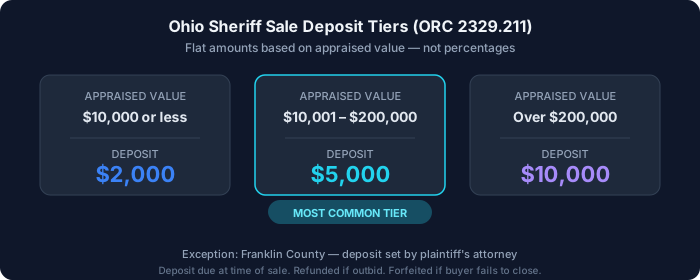
One exception: Franklin County. There, the plaintiff's attorney sets the deposit amount at their discretion rather than following the statutory tiers. If you're bidding in Franklin County, check the specific listing.
Your deposit is due at the time of sale. Win and don't complete the purchase? You forfeit the deposit. Get outbid? Refunded.
Step 3: Know the minimum bid rules
Ohio has a two-thirds rule, but it only applies to the first sale.
On a first sale (ORC 2329.20), the property cannot sell for less than two-thirds of its appraised value. Appraised at $120,000? The minimum bid is $80,000. No exceptions.
If nobody bids at least two-thirds, the property goes to a second sale (ORC 2329.52) within 7 to 30 days. At the second sale, there is no minimum bid. The property sells to the highest bidder regardless of price.
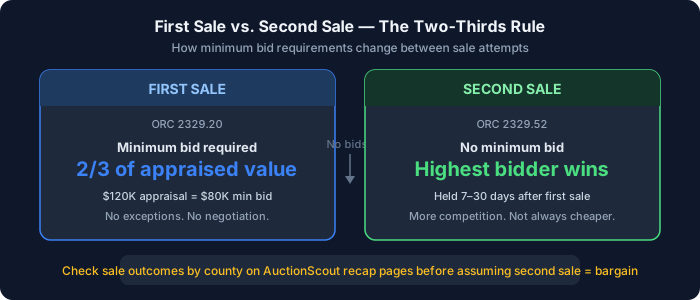
A lot of experienced investors focus on second sales for exactly this reason. That $120,000-appraisal property that didn't sell at the first sale could go for well under that floor. But everyone else knows this too, so competition at second sales can be fierce.
Our county recap pages show each county's sale results, sale rate and sale prices. Worth checking the data before assuming a second sale means a guaranteed bargain.
Step 4: Research the property before you bid
This is the step most people rush through, and it's the one that costs the most when you get it wrong. You cannot inspect the interior of sheriff sale properties before bidding. You're buying based on what you can see from the sidewalk, what you can pull from public records, and your own analysis.
Title search. Pull the case docket from the court. Look at every named defendant. Junior liens (second mortgages, judgment liens, mechanic's liens) are only extinguished if the holders were properly named and served in the foreclosure action. If a lienholder was missed, their lien survives the sale. It becomes your lien.
Surviving liens. Some liens survive every sheriff sale regardless of who was named in the case. You need to check for all of these:
- Property tax liens (always first priority)
- Special assessments (street, sidewalk, sewer projects certified to the county auditor)
- Water and sewer liens (when certified to the county auditor)
- Municipal code violation liens (demolition or boarding costs)
- IRS federal tax liens (these survive the sale, and the IRS gets a 120-day right to buy the property from you at the price you paid)
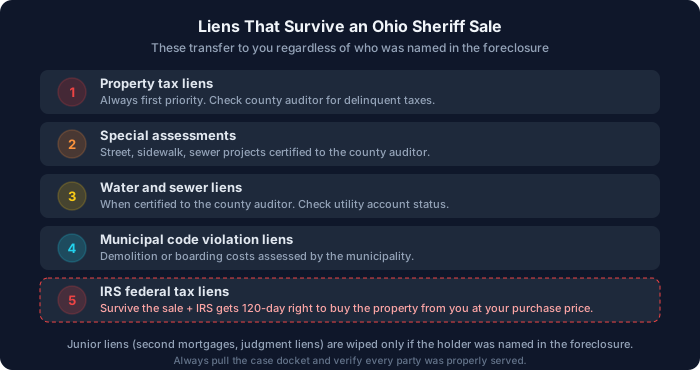
That IRS redemption right is the one that catches people. If there's a federal tax lien on the property, the IRS has 120 days after the sale to essentially take it from you by reimbursing your purchase price. Doesn't happen often, but it happens. Some investors won't touch properties with IRS liens. Others bid lower to account for the risk.
Drive the property. Go look at it. Check the roof, siding, windows, foundation (what you can see from the sidewalk). Look at the neighboring properties too. And check for signs of occupancy. If someone is living there, you'll need to handle eviction after the sale, which adds time and cost.
Run the numbers. After-repair value. Renovation costs. Realistic profit margin after holding costs, closing costs, and the stuff you can't see from the curb.
Our AI analysis at AuctionScout pulls comparable sales data from multiple national valuation sources, generates renovation estimates, and, in the Deal Analysis tab, compares each property as a flip, a BRRRR or long-term rental, and a short-term rental. You can run this on any property before the auction starts. Try it free for 14 days.
Step 5: Place your bid
On auction day, log into RealAuction and find the property listing. The bidding process is similar to eBay:
- Confirm the property address, appraised value, deposit amount, and case number
- Enter your maximum bid amount. RealAuction uses proxy bidding, so the system bids incrementally on your behalf up to your max
- Stay logged in until the auction closes. Last-minute bids can extend the auction window
Decide your maximum bid before the auction starts. Write it down. Stick to it. Auction fever is real, and it's how people overpay. Your number should come from your analysis, not from watching someone else bid $5,000 more.
Step 6: After you win
Winning the auction starts a multi-step process that most new bidders don't fully anticipate.
You'll submit your deposit (per the statutory tiers above) to the county sheriff's office. Then the court needs to confirm the sale, which typically takes 30 to 60 days depending on the county. During that window, the previous owner or other parties can file objections. Objections succeeding is uncommon, but confirmation isn't automatic.
Once confirmed, you'll get a deadline (usually 30 days) to pay the remaining balance: total purchase price minus your deposit. Thirty days is too short for a conventional mortgage, so decide how you are funding the balance before you raise your hand, not after. After full payment, the sheriff issues a deed. File it with the county recorder.
If the property is occupied, you may need to go through eviction. If it's vacant, change the locks and secure it immediately. Vacant properties attract theft fast. Copper pipes and HVAC systems go first.
Common mistakes first-time bidders make
The most expensive one: not checking the case docket. If a junior lienholder wasn't named in the foreclosure, their lien survives. A $30,000 second mortgage that wasn't properly extinguished becomes your $30,000 second mortgage. It can happen to any new investor who skips the docket review to save a few hours.
Assuming "no minimum" means "cheap." Second sales attract experienced investors who know the same thing you know. You won't be the only one at the table.
Ignoring holding costs. Between winning the auction and selling or renting the property, you're paying property taxes, insurance, utilities (to prevent pipe freeze), and maintenance. On a $100,000 property, holding costs can run $800 to $1,200 per month. A flip that takes six months longer than expected can eat your entire margin.
Skipping the drive-by. Photos lie. Google Street View is outdated. Go look at the property. Look at it at different times of day if you can.
Forgetting about the IRS. Federal tax lien on the property means 120 days of uncertainty. Nobody should ignore it.
Frequently asked questions
Do I need cash to buy at a sheriff sale?
You need the deposit in certified funds at the time of sale, and the balance is typically due within 30 days of court confirmation. Some investors use hard money loans or private lending, but traditional mortgages don't work here because there's no inspection contingency or standard closing process.
Can I get title insurance on a sheriff sale property?
Yes. Because Ohio uses judicial foreclosure, title insurance companies will generally insure a sheriff's deed as long as the title search is clean. If there are defects (missed lienholders, service issues), you may need a quiet title action first. That typically costs $1,500 to $3,000 and takes two to six months.
What happens if I'm the only bidder?
On a first sale, you still need to bid at least two-thirds of the appraised value. Meet the threshold, you win. On a second sale, any bid wins if there's no competition.
Can I bid on properties in multiple counties?
Yes. One RealAuction registration works across all 88 Ohio counties. Bid on properties in Cuyahoga County, Hamilton County, and Summit County from the same account.
How do I find which properties are coming up for auction?
County sheriff offices publish upcoming sale lists on RealAuction. But those listings give you an address and a case number. They don't tell you what the property is worth, what it needs in repairs, or whether it's a good deal.
We aggregate auction data across Ohio, run AI-powered valuations, and compare every property by investment strategy in the Deal Analysis tab. Set up alerts on AuctionScout and get notified when properties matching your criteria hit the calendar. Takes 30 seconds.
Get ahead of your first bid
The bidding process is mechanical once you know the rules. Registration, deposits, minimum bids, confirmation. None of that is hard.
Knowing which properties are worth bidding on? That part is hard. And it's the reason we built AuctionScout. Set up your free account at auctionscout.app and run analysis on properties before your next auction. Fourteen-day free trial, no credit card required.