
In a traditional real estate deal, you make an offer, then do your homework. You get inspections, financing contingencies, title review periods. If something looks wrong, you walk away and get your earnest money back.
Ohio sheriff sales don't work that way. There are no contingencies. No inspection period. No financing contingency. No appraisal contingency. You bid, you win, you pay, you own it. Whatever "it" turns out to be.
That means all your due diligence happens before you raise your hand. This ohio sheriff sale due diligence checklist covers 12 steps serious investors should work through before placing a bid. Skip any of them and you're gambling, not investing.
The 12-step overview
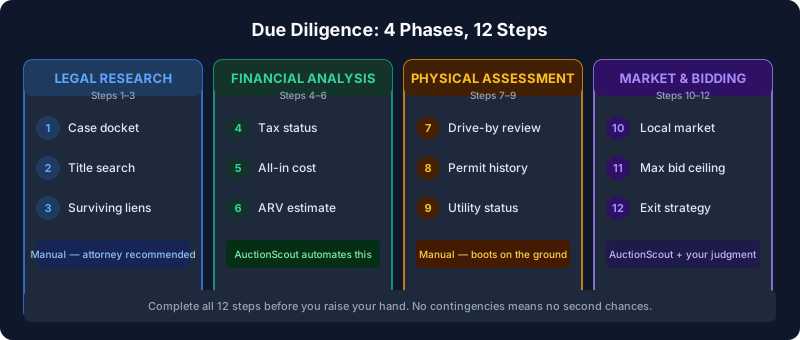
The steps break into four groups:
- Steps 1-3: Legal research (title, liens, judgment review)
- Steps 4-6: Financial analysis (taxes, assessments, after-repair value)
- Steps 7-9: Physical assessment (exterior review, permits, utilities)
- Steps 10-12: Market and bidding (comps, deposit prep, exit strategy)
We'll go through each one with where to look, what you're looking for, and why it matters.
Steps 1-3: Legal research
Step 1: Pull the case docket
Start at the county clerk of courts website. Search for the case number listed on the sheriff sale notice. You're looking for three things: who filed the foreclosure, which defendants were named, and whether all parties were properly served.
This matters because junior liens are only extinguished if the lien holders were named as defendants in the foreclosure and properly served. If a second mortgage holder or judgment creditor wasn't served, their lien survives the sale and becomes your problem. Check every named defendant's service status on the docket.
The foreclosure type also tells you what's happening. Most Ohio sheriff sales are judicial foreclosures filed under ORC Chapter 2329, where a bank or lender goes through court to force the sale. You'll occasionally see tax foreclosures too, which follow different rules.
Step 2: Run a title search
Go to the county recorder's office (most are searchable online now) and pull up the property's deed history. You're tracing the chain of title and looking for anything unexpected: unrecorded easements, boundary disputes, lis pendens from other actions, or prior conveyances that don't line up.
A common misconception: people think you can't get title insurance on a sheriff sale property. You can. Because Ohio uses judicial foreclosure, title companies will generally insure a sheriff's deed if the title search comes back clean. A quiet title action (typically $1,500 to $3,000, taking 2 to 6 months) is only needed when defects exist, not as a default step.
Step 3: Identify surviving liens
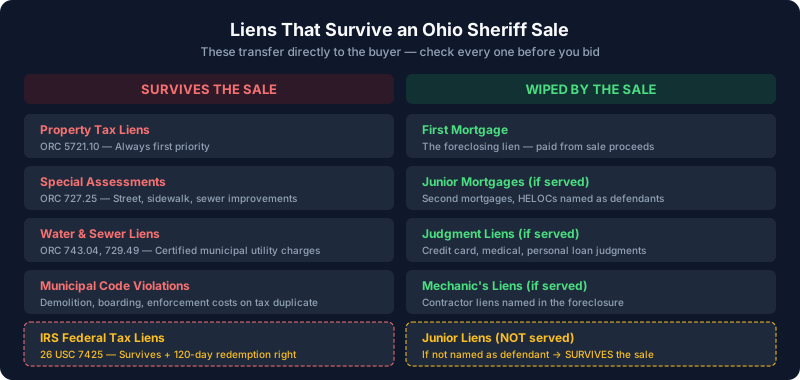
Most new investors assume a sheriff sale wipes everything clean. It doesn't. Some liens survive the sale and transfer directly to you as the new owner.
Here's what survives:
- Property tax liens (ORC 5721.10). Always first priority. If the property has delinquent taxes, you're buying them too.
- Special assessments (ORC 727.25). Street, sidewalk, or sewer improvement charges that have been certified to the county auditor.
- Water and sewer liens (ORC 743.04, 729.49). Municipal utility charges certified to the county auditor.
- Municipal code violation liens. Demolition costs, boarding costs, or other code enforcement charges certified to the tax duplicate.
- IRS federal tax liens (26 USC 7425). These survive the sale. On top of that, the IRS gets a 120-day redemption right, meaning they can buy the property from you at the price you paid for up to 120 days after the sale. This isn't theoretical. It happens.
Check the county treasurer, county auditor, and municipal utilities for each of these. If the combined surviving liens eat your margin, walk away.
Steps 4-6: Financial analysis
Step 4: Check tax status
Pull up the property on the county auditor's website. You want to see the current tax valuation, any delinquent taxes owed, and any pending special assessments. Ohio counties also publish the "tax duplicate," which shows all charges certified against the property.
Remember, delinquent property taxes survive the sheriff sale. If the property owes $8,000 in back taxes, that's $8,000 added to your cost basis on top of your winning bid.
Step 5: Calculate your all-in cost
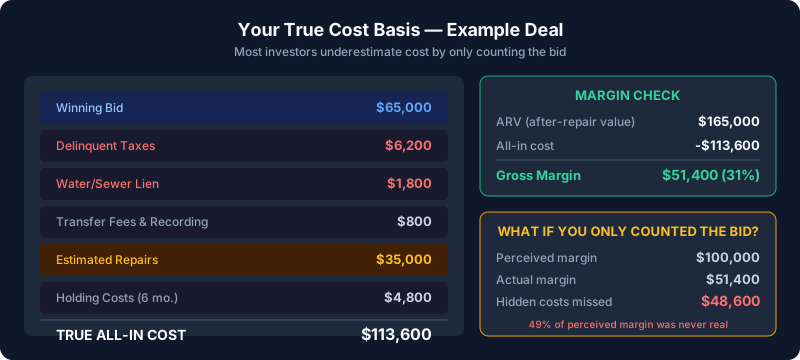
Your all-in cost is not just your bid. Most investors who lose money on sheriff sales lose it here, by underestimating the true cost. Add it all up:
- Winning bid amount
- Surviving liens (from Step 3)
- Delinquent taxes (from Step 4)
- Deposit (paid at auction, held against your bid)
- Transfer fees and recording costs
- Estimated repair costs (from Steps 7-9)
- Holding costs (insurance, taxes, utilities during rehab or rental prep)
Ohio deposits are statutory flat-dollar amounts, not percentages. Under ORC 2329.211, the deposit tiers for residential foreclosures are:
| Appraised Value | Required Deposit |
|---|---|
| $10,000 or less | $2,000 |
| $10,001 to $200,000 | $5,000 |
| Over $200,000 | $10,000 |
One exception: Franklin County, where the plaintiff's attorney sets the deposit at their discretion.
Step 6: Estimate after-repair value (ARV)
Pull comparable sales within a half-mile radius, sold in the last 6 months, with similar square footage, bed/bath count, and condition. County auditor websites and MLS data both work here.
Be conservative. The comps you're using need to reflect what the property will be worth after your planned improvements, not the best-case scenario where everything goes right. Subtract your all-in cost from Step 5, and that's your actual margin. If it's less than 15-20% on a flip, the deal probably isn't worth the risk of buying without an inspection.
Steps 7-9: Physical assessment
Step 7: Drive-by exterior inspection
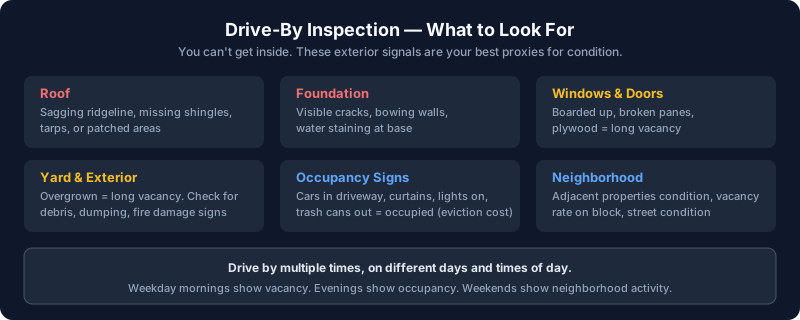
You can't get inside the property before a sheriff sale. But you can drive by, and you should. Multiple times if possible, on different days.
Start with the roof. Sagging ridgelines, missing shingles, or tarps are all red flags. Look at the foundation for visible cracks. Check for boarded windows, overgrown yards (a sign of long vacancy), water staining on exterior walls, and any evidence of fire damage. Also note whether the property appears occupied.
Occupied properties add complexity. If someone is living there (the former owner, a tenant, or a squatter), you'll need to go through Ohio's eviction process after the sale. Budget time and legal costs for that.
Step 8: Pull permit history
Check the municipality's building department records for permit history. Recent permits for roofing, electrical, plumbing, or structural work tell you what's been done. The absence of permits for obvious recent work tells you it was done without permits, which can mean code enforcement headaches down the road.
Also check for any open permits. An open permit means someone pulled a permit, started work, and never got the final inspection. You'll inherit that problem.
Step 9: Check utility status
Call the local water, sewer, and electric utilities. Ask whether service is active or disconnected and whether there's an outstanding balance. In some Ohio municipalities, unpaid water and sewer bills create liens that survive the sheriff sale (see Step 3).
A property with disconnected utilities may need new service connections, which can cost thousands. A property with active service where someone is still living there confirms occupancy, which informs your eviction timeline.
Steps 10-12: Market context and bidding strategy
Step 10: Research the local market
Before you bid, understand what the market is doing in that specific county and zip code. What are properties selling for? How long are they sitting? What's the rental market look like if you're planning to hold?
We track weekly sheriff sale data across Ohio on our county recap pages. You can see how many properties listed, how many sold, sale prices, and the discount to est. market value. This tells you whether discounts in that county are thin or leave more room.
Check the recap pages for Franklin County, Cuyahoga County, Lucas County, Hamilton County, Summit County, and Mahoning County for examples of how different the numbers can look county to county.
Step 11: Set your max bid before the auction
Set a firm ceiling based on your ARV, all-in cost, and minimum acceptable margin. Write it down. Literally, on paper, before the auction starts. Auction environments create pressure to bid one more time, and that one more time is where margins disappear.
Your max bid formula: ARV minus repair costs minus holding costs minus surviving liens minus your minimum profit target. That's the number. If bidding passes it, you walk.
On first sale, the minimum bid is two-thirds of the appraised value (ORC 2329.20). If the property doesn't sell at first sale, it goes to a second sale within 7 to 30 days with no minimum bid (ORC 2329.52). Sometimes waiting for the second sale is the right play.
Step 12: Plan your exit before you bid
Know your exit strategy before you bid. Are you flipping? Holding as a rental? Wholesaling? Each strategy has different margin requirements and different timelines.
Flips need the widest margins because you're carrying the property, improving it, and selling it. One surprise (structural issue, slow resale market, contractor delays) can eat your profit. Buy-and-hold needs less discount upfront but requires the rental math to work: monthly rent minus mortgage, taxes, insurance, and maintenance needs to cover vacancy and still cash flow.
Don't bid without knowing which exit applies and whether the numbers support it.
Red flags that should stop you from bidding
Some issues are worth solving. Others should make you walk away entirely.
Walk away if:
- IRS federal tax liens are present (120-day redemption risk plus the lien amount)
- Total surviving liens exceed 20% of your estimated ARV
- Multiple code violation liens suggest systematic neglect by the municipality
- The property has environmental contamination flags (former gas station, dry cleaner, industrial use)
- Open permits for structural work with no final inspection
- The foreclosure case docket shows service issues with named defendants (surviving junior liens risk)
- You can't determine occupancy status and don't have eviction budget/timeline flexibility
Any one of these can turn what looked like a 30% margin into a net loss. Walking away from a bad deal is free. Winning one is expensive.
How AuctionScout automates steps 4-6 and 10-11
Steps 4 through 6 (tax status, all-in cost calculation, and ARV estimation) and steps 10 through 11 (market research and bid ceiling) are the most time-consuming parts of this checklist. They're also the most data-intensive, which means they're well suited for automation.
AuctionScout pulls county tax data, calculates estimated all-in costs, and provides AI-powered property valuations for ARV estimation. The weekly county recap pages give you the market context for Step 10 without manually tracking sale rates and discount levels across every county.
The legal steps (1-3) and physical steps (7-9) still need your direct involvement. No tool replaces reading a case docket or driving past a property. But the financial and market analysis steps are where hours of spreadsheet work can become minutes.
FAQ
Do I need a real estate attorney for sheriff sale due diligence?
You don't legally need one, but having a real estate attorney review your first few deals is worth the cost ($500 to $1,000 for a consultation). They can catch title issues you might miss and help you understand the case docket. Once you've done 5 to 10 deals, you'll know the patterns well enough to handle most of the legal research yourself.
Can I inspect the inside of a property before a sheriff sale?
No. Ohio sheriff sales are sold as-is with no interior access. That's why the exterior drive-by (Step 7) and permit history (Step 8) matter so much. They're the best proxies you have for interior condition.
How long do I have to pay after winning a sheriff sale bid?
Typically 30 days from the confirmation of sale, though this varies by county. The deposit is paid at auction (see the deposit table in Step 5). The balance is due after the court confirms the sale. If you don't pay, you forfeit the deposit.
What happens if the property has tenants?
Existing tenants don't automatically lose their rights at the sheriff sale. If there's a valid lease, you may need to honor it. If there's no lease (month-to-month or holdover), you'll go through the standard Ohio eviction process. Budget 30 to 90 days and $500 to $2,000 in legal costs.
Is title insurance really available on sheriff sale properties?
Yes. Ohio's judicial foreclosure process creates a court-supervised chain of title that title companies can insure. If the title search is clean and all parties were properly served in the foreclosure, most title companies will issue a policy. You'd only need a quiet title action ($1,500 to $3,000, 2 to 6 months) if defects are found.
We built AuctionScout to handle the financial and market analysis steps so you can spend your time on the parts that actually need a human, reading case dockets and driving past properties. Start your free 14-day trial and see the data for your target counties.