
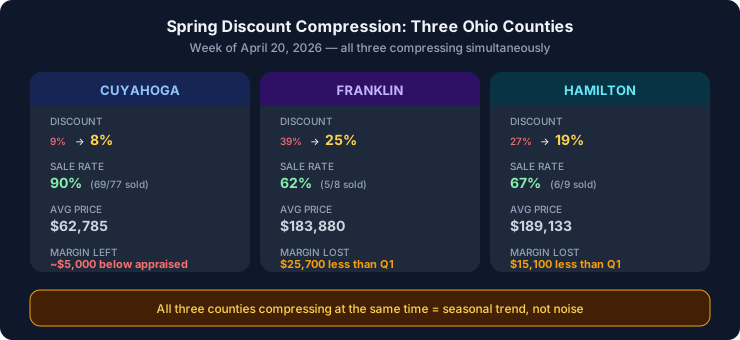
Ohio sheriff sale discounts in 2026 are compressing across every major county we track. Cuyahoga's average discount dropped to 8% on 77 listings with a 90% clearance rate. Franklin fell from 39% to 25%. Hamilton went from 27% to 19%, while its sale rate doubled from 33% to 67%. Spring competition is here, and the margins investors counted on three months ago are getting thinner by the week.
We've been watching this pattern build since March. The data from the week of April 20 confirms it: discounts are shrinking, clearance rates are climbing, and the window for easy deals is closing.
If you're bidding with assumptions from Q1, your numbers are already stale.
The numbers: county-by-county discount compression
Three counties tell the story. All three are moving in the same direction.
Cuyahoga County (week of Apr 20): 77 listed, 69 sold, 90% sale rate, $62,785 average price, 8% average discount. The discount was 9% just weeks earlier. At these levels, the average property sold for roughly $5,000 below appraised value. On a $63K property, that's barely enough to cover closing costs and transfer taxes, let alone leave room for renovation surprises. (See live Cuyahoga data)
Franklin County (week of Apr 20): 8 listed, 5 sold, 62% sale rate, $183,880 average price, 25% average discount. Franklin still has the deepest discount of the three. But that 25% was 39% not long ago. On a $184K property, the difference between a 39% discount and a 25% discount is about $25,700 in lost margin. That's your renovation budget evaporating. (See live Franklin data)
Hamilton County (week of Apr 20): 9 listed, 6 sold, 67% sale rate, $189,133 average price, 19% average discount. Hamilton's sale rate doubled from 33% to 67%. More bidders, more properties clearing, less room to negotiate. The discount compressed from 27% to 19%, which on a $189K property means about $15,100 less breathing room than earlier this year. (See live Hamilton data)
These aren't random fluctuations. All three counties are compressing at the same time. That's seasonal, not noise.
Why discounts shrink in spring
The mechanics aren't complicated. Spring brings more buyers into the market. More buyers at auction means more aggressive bidding. More aggressive bidding means final sale prices creep closer to appraised values.
Hamilton's data makes this visible. A sale rate jumping from 33% to 67% means twice as many listed properties found a buyer. When demand doubles, sellers (in this case, the bank holding the judgment) don't need to accept deep discounts to clear inventory. Buyers compete against each other, and the discount compresses on its own.
This happens every year, but the severity varies. What makes 2026 notable is how quickly it's happening. Cuyahoga went from 9% to 8% while maintaining 90% clearance on a high-volume week. That combination (thin margins plus near-total absorption) is a signal that the market isn't just competitive. It's leaving almost nothing on the table.
The Cuyahoga volume trap
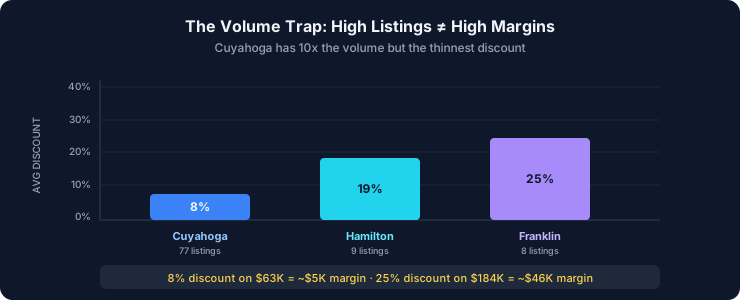
Cuyahoga draws investors because of volume. Seventy-seven listings in a single week dwarfs Franklin's eight or Hamilton's nine. If you're looking to build a pipeline, Cuyahoga seems like the obvious choice.
But the discount tells a different story. At 8% average discount on a $62,785 average price, you're buying roughly $5,000 below appraised value. That $5,000 has to absorb your deposit, your title work, your transaction costs, and any repair surprises. For a flipper, there's almost no margin left. For a buy-and-hold investor, the entry price advantage over retail is minimal.
The 90% clearance rate means almost everything sells. That sounds good until you realize what it implies: buyers are willing to pay within 8% of appraised value on nearly every property. You're not picking through inventory for hidden deals. You're competing with a crowd for thin margins.
We're not saying avoid Cuyahoga. But if you're drawn to it for volume alone, run the math on what an 8% discount actually leaves you after costs. For many deals at that average price point, the answer is not much.
Where the margin still is (and how to track it weekly)
Franklin at 25% has the most room of the three major counties. A 25% discount on a $184K average gives you roughly $46K below appraised value. That's real margin, even after accounting for renovation, holding costs, and the unknowns that come with every sheriff sale.
But Franklin compressed from 39% to 25%. That's a 14-point swing. If it keeps compressing at that pace, the margin advantage over Hamilton (currently 19%) could disappear within a few weeks.
The investors who do well in a compressing market are the ones tracking this data weekly, not monthly. By the time you notice compression on a monthly check, it's already eaten into your returns for two or three deals. Weekly tracking lets you see the trend while there's still time to adjust your max bid, shift to a different county, or sit out a cycle entirely.
We update county recap pages every week with sale rates, average discounts, average prices, and trend charts. If you're bidding in any of these counties, check the data before you set your max bid, not after.
What to do with this data
None of this means stop investing. It means tighten up.
First, recalculate your max bids. If you've been using discount assumptions from January or February, those numbers are wrong now. Cuyahoga at 8% is a different market than Cuyahoga at 12%. Price your bids to the current week's data, not last quarter's.
Second, look at counties where competition hasn't arrived yet. Ohio has 88 counties. The three we covered are the highest-volume markets. Smaller counties with less investor attention may still have wider discounts. The tradeoff is lower volume and less liquidity, but the margins can be better.
Third, track weekly, not monthly. Compression moves fast in spring. A monthly check means you're always behind. Weekly tracking lets you catch shifts before they cost you money.
And if discounts compress below your minimum margin threshold, sit it out. There's no rule that says you have to bid every week. The worst outcome isn't missing a deal. It's winning one at a price that doesn't work.
AuctionScout's county recap pages update weekly with sale rates, average discounts, and trend charts for every major Ohio county. Track the compression before you bid. Try AuctionScout free for 14 days.