Most investors doing due diligence on Ohio sheriff sale properties are running the same clunky process: county website in one tab, auditor records in another, Zillow for comps, a spreadsheet to track it all, and a phone full of drive-by photos that never get organized. For a single property, that's manageable. For five properties on next week's Franklin County docket, it's a full day of work before you even decide which ones are worth bidding on.
We built AuctionScout's due diligence checklist to compress that workflow. Everything lives in one place, organized per property, with the auction-specific items that generic real estate checklists miss entirely.
The Tuesday night problem
It's Tuesday. The Franklin County sheriff sale is next Wednesday. You pull the docket and see 28 properties. Appraised values range from $45,000 to $310,000. You're a buy-and-hold investor looking for rental properties under $150,000 with a realistic path to positive cash flow after rehab.
That filters you down to maybe 12 properties worth a first look. But "first look" in sheriff sale investing means answering a dozen questions per property before you can make a bid decision:
What liens survive the sale? What's the tax status? Is the property occupied? What's the condition from the outside? What did comparable properties sell for recently? What's the deposit requirement? Is this a first sale or second sale?
Multiply that by 12 properties and you're looking at hours of research across scattered sources. Most investors either rush through it and miss something, or only research three or four properties and hope one works out.
What the checklist actually covers
AuctionScout's due diligence checklist is structured around what sheriff sale investors specifically need. Every property in your project gets its own checklist, and each item maps to a real decision point.
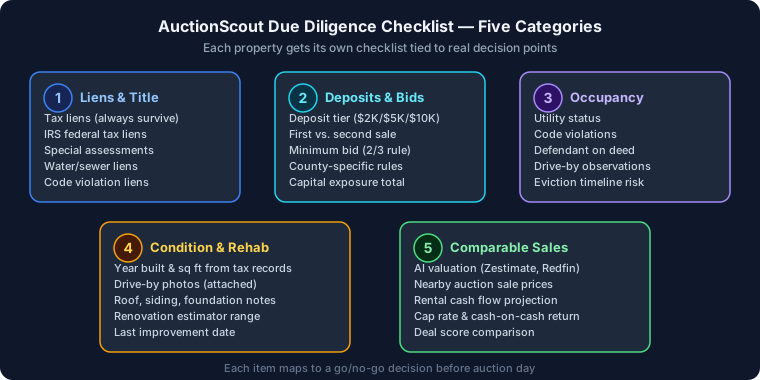
Lien and title status is where sheriff sales get dangerous if you're not thorough. Property tax liens always survive the sale (ORC 5721.10). IRS federal tax liens survive too, and the IRS gets a 120-day redemption right to buy the property from you at your purchase price. Special assessments, water and sewer liens certified to the county auditor, municipal code violation liens for demolition or boarding costs. All of these can survive. Junior liens only get wiped if the holders were properly named and served in the foreclosure action. The checklist tracks each lien type so nothing falls through.
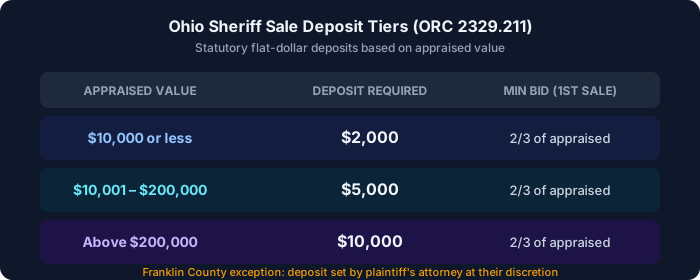
Deposits and bid requirements are the next layer. Deposits follow statutory flat-dollar tiers based on appraised value: $2,000 for properties appraised at $10,000 or less, $5,000 for $10,001 to $200,000, and $10,000 for anything above $200,000 (ORC 2329.211). Franklin County is the exception, where the plaintiff's attorney sets the deposit at their discretion. First sale requires a two-thirds minimum bid. Second sale, no minimum. The checklist flags which sale type each property is on, so you know your capital exposure before you show up.
Then there's occupancy. You can't inspect a sheriff sale property before the auction. But you can look for signs: utility status, recent code violations, exterior condition from a drive-by, whether the foreclosure defendant is still on the deed. The checklist gives you a place to record what you find and what you couldn't verify.
For condition and renovation scope, the renovation estimator works from exterior data. Tax records show the year built, square footage, and last improvement date. Upload your drive-by photos directly to the property. Add notes about the roof, siding, foundation cracks, yard condition. Everything stays attached to the property instead of scattered across your camera roll and a spreadsheet you'll forget to update.
Finally, comparable sales. The AI valuation pulls from Zestimate, Redfin, and Realtor.com data alongside comparable auction sales in the same area. For a buy-and-hold investor, the rental cash flow projection (cap rate, cash-on-cash return, IRR) matters more than the flip ARV. Deal scoring shows both so you can compare strategies on each property.
Five properties, one evening
Let's walk through what this looks like in practice. You're evaluating five properties from the Franklin County docket, all under $120,000 appraised value.
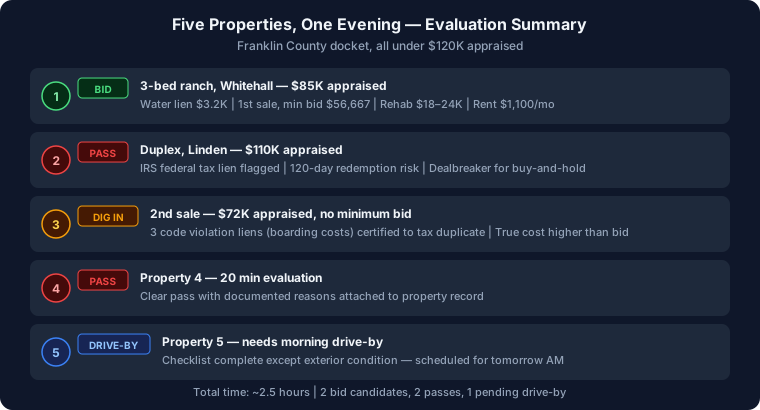
Property one: $85,000 appraised, 3-bed ranch in Whitehall. Checklist shows a surviving water/sewer lien of $3,200 certified to the auditor. First sale, so the minimum bid is $56,667 (two-thirds of appraised). Deposit is $5,000. Drive-by photos show a missing gutter section and peeling paint, but the roof looks recent. Renovation estimator puts rehab at $18,000 to $24,000. Rental comp analysis shows $1,100/month for the area. You mark this one as "bid candidate" and move on.
Property two: $110,000 appraised, duplex near Linden. The checklist flags an IRS federal tax lien. That means the lien survives and the IRS has 120 days to buy it from you at your purchase price. For a buy-and-hold play, that uncertainty might be a dealbreaker. You mark it "pass" with a note about why.
Property three: $72,000 appraised, second sale. No minimum bid. But the checklist shows three code violation liens for boarding costs that were certified to the tax duplicate. Those survive. Your true acquisition cost is higher than the sale price suggests. You dig deeper or pass.
Properties four and five take about 20 minutes each. By 9 PM, you have two solid bid candidates with full research attached, two clear passes with documented reasons, and one that needs a drive-by tomorrow morning. Total time: roughly two and a half hours. The same work used to take most of a weekend.
What generic checklists miss
We've seen investors use BiggerPockets checklists, their own spreadsheet templates, even Notion databases. They all have the same problem: they were built for conventional real estate transactions where you get inspections, contingencies, and title insurance before closing.
Sheriff sales don't work that way. No inspection. No contingencies. No financing contingency. You bring certified funds and close on confirmation. Title insurance is available on sheriff sales (Ohio uses judicial foreclosure, so title companies will generally insure a clean sheriff's deed), but you still need to verify the title is actually clean. A quiet title action costs $1,500 to $3,000 and takes two to six months if defects exist.
A due diligence checklist built for this process needs to account for surviving liens by type, sale sequence (first vs. second), county-specific deposit rules, and condition assessment without interior access. That's what we built.
Your next auction batch
If you're still running due diligence across five browser tabs and a spreadsheet, try running your next batch through AuctionScout's checklist. Pick the properties from your county's upcoming docket, run the AI analysis, fill in the checklist items, and see how much faster you get to a bid or pass decision on each one.
Try AuctionScout's due diligence checklist on your next batch of sheriff sale properties. Start your free 14-day trial.