
Two paths lead to auction properties in Ohio. One runs through national online platforms like Auction.com. The other goes directly through county sheriff sales. They look similar from the outside, but the fee structures, transparency, and risk profiles are different enough to change your returns on a deal.
Most investors default to whichever path they stumble on first. That's a mistake worth thousands of dollars per property.
How platform-based auctions work
Auction.com is the biggest name in online real estate auctions. The platform lists bank-owned (REO) properties and foreclosures from institutional sellers across the country. You bid online, and if you win, you close within a set timeframe.
Here's what you're working with:
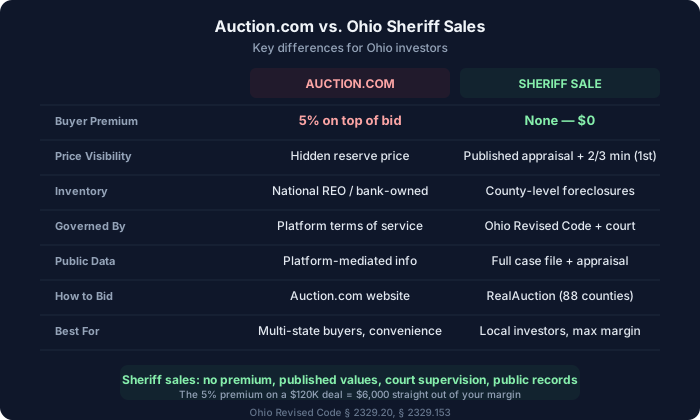
Inventory. National REO and bank-owned properties. The banks set reserve prices, but those reserves aren't published. You're bidding without knowing the floor.
Buyer's premium. This is the big one. Auction.com charges a 5% buyer's premium on top of your winning bid. That's not a closing cost. That's an extra fee paid to the platform, and it comes straight out of your margin.
Process. Online bidding with set auction windows. Properties are sold as-is. You typically can't access the interior before bidding, though some listings allow drive-by inspections or provide property condition reports.
Closing. Standard title company closing, usually within 30-45 days. Financing is sometimes available depending on the property and seller.
The platform does a good job of aggregating inventory across states. If you're looking to buy foreclosures in multiple markets from your laptop, the convenience is real. But you're paying for that convenience.
How Ohio sheriff sales work
Ohio sheriff sales are court-supervised foreclosure auctions run at the county level. When a borrower defaults on a mortgage, the lender files in Common Pleas Court, the court orders a sale, and the county sheriff's office handles the auction.
The mechanics are different from platform auctions in several important ways.
No buyer's premium. Zero. Your winning bid is your purchase price. There's no 5% fee layered on top.
Published appraised values. Ohio courts appoint appraisers for each property. That appraised value is public record. For mortgage foreclosure cases, the opening bid minimum is two-thirds of the appraised value. You know the floor before you show up.
Online bidding through RealAuction. Most Ohio counties now run their sheriff sales on the RealAuction platform. You register, get approved, and bid online. This isn't a courthouse-steps-only process anymore.
Court supervision. Every sale must be confirmed by the court. The process is governed by Ohio Revised Code, not platform terms of service. Sale results are public record.
Due diligence. Properties are still sold as-is, and interior access before auction is uncommon. But you can pull the full case filing from the court docket, review the appraisal, check tax records, and research title history through county recorder records. All public.
The downside? Inventory is county-by-county. There's no single national dashboard. Each county runs its own schedule, its own listings, and its own registration process. If you're watching Franklin, Cuyahoga, Hamilton, and Summit counties, that's four different systems to monitor.
The fee math on a real deal
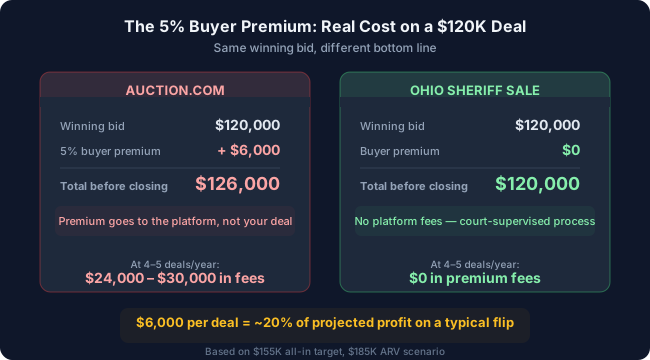
Let's make this concrete. Say you win a property at $120,000.
Through Auction.com: Your winning bid is $120,000. The 5% buyer's premium adds $6,000. Your total cost before closing is $126,000.
Through an Ohio sheriff sale: Your winning bid is $120,000. No buyer's premium. Your total cost before closing is $120,000.
That's $6,000 per deal. On a property where your all-in rehab budget targets $155,000 for an ARV of $185,000, that $6,000 represents roughly 20% of your projected profit. On tighter deals, it can eat the entire margin.
Scale that across four or five deals a year and you're looking at $24,000 to $30,000 in premium fees that go to the platform, not into your rehab or your pocket.
Transparency and risk
This is where the two paths pull apart.
Ohio sheriff sales operate in public view. The case filings are on the court docket. The appraisal is published. The sale results are recorded. If you want to research a property's legal history, the mortgage balance, or the foreclosure timeline, it's all available through court records.
Platform auctions are mediated. The bank sets a reserve price, but you don't see it. Property condition information varies by listing. The sale terms are governed by the platform's agreement, not by statute.
Neither path eliminates risk. You're still buying property as-is, usually without interior access. Title issues can exist in both channels (Ohio sheriff sales convey through a sheriff's deed, which has its own implications for title insurance). But on the sheriff sale side, you have more raw data available to make your decision before you bid.
Published appraised values alone are a significant advantage. On a platform auction, you're guessing where the reserve sits. On a sheriff sale, you know the court-appointed appraisal and the two-thirds minimum bid. That changes how you underwrite a deal.
Which path fits which investor
Direct Ohio sheriff sales tend to favor investors who:
- Live in Ohio or have boots on the ground locally
- Have contractor relationships for rehab estimates based on exterior inspections
- Are comfortable pulling court records and doing their own title research
- Want to maximize margins by avoiding platform fees
- Focus on a handful of counties and know those markets well
Platform-based auctions can work for investors who:
- Buy across multiple states and want one interface for everything
- Prefer a wider national funnel of REO inventory
- Value the platform experience and are willing to pay the 5% premium for convenience
- Don't have deep local market knowledge and rely on platform-provided property details
There's no wrong answer. It depends on your strategy, your market knowledge, and how much that 5% matters to your deal math.
How AuctionScout makes the direct path easier
The biggest barrier to Ohio sheriff sales has always been the fragmentation. Eighty-eight counties, each with its own schedule and listings. No single place to search, compare, and analyze properties across the state.
That's exactly what we built AuctionScout to solve.
We track sheriff sale data across every Ohio county. You get property listings with published appraised values, sale dates, and case details in one dashboard. Our AI-generated ARV estimates give you a quick comparable value check before you dig deeper. Set up alerts for specific counties or price ranges and get notified when new properties hit the docket.
You can see this in practice. Our Franklin County recap shows recent sale results for the Columbus metro, and the Cuyahoga County page covers Cleveland.
The direct sheriff sale path already saves you the 5% buyer's premium. AuctionScout makes it practical to work that path across multiple counties without it becoming a second job.
AuctionScout Pro is $49/month with a 14-day free trial, no credit card required. Set up your county alerts, takes about 30 seconds.