Lancaster County listed 51 properties for sheriff sale in October 2026. Four sold to third-party buyers. That's an 8% clearance rate.
Investors moving from Ohio, where clearance rates typically run 40-60%, tend to read a number like that as a broken market. It isn't. It's the PA sheriff sale upset price doing exactly what it was designed to do, and understanding it is the prerequisite for investing in Pennsylvania auctions at all.
This guide explains the mechanic, runs through the actual math, and shows when third-party buyers do win.
What the upset price actually is
Every PA sheriff sale has a minimum bid called the upset price. The first thing to know about it: it has nothing to do with market value.
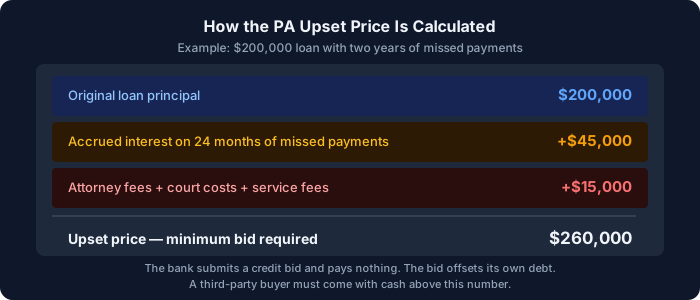
Ohio's minimum bid is two-thirds of the sheriff's appraised value, which is pegged to market value. Pennsylvania doesn't publish appraisals for foreclosed properties and doesn't use market value as its floor. Instead, the upset price is the total judgment debt: the outstanding loan principal, plus accrued interest on all missed payments, plus the plaintiff's attorney fees, plus court costs.
On a loan that's been in default for two or three years, that figure includes a lot of interest. Courts, process servers, and attorneys all add costs. A $200,000 original mortgage might carry a $260,000-$280,000 upset price by the time the auction happens.
That's the mechanical reason why PA clearance rates look nothing like Ohio's. It's not volume, it's not court calendars. It's arithmetic.
How the credit bid works, and why banks almost always win
The lender holding the judgment doesn't need to bring cash to a PA sheriff sale. They submit what's called a credit bid, which is simply a bid equal to or above the upset price that offsets against the debt they're owed rather than requiring a cash payment.
If the lender credit bids $265,000 against a $265,000 judgment, nothing changes hands. The deed transfers to the bank at no out-of-pocket cost.
A third-party investor who wants to outbid the bank has to pay cash. So the question is whether a property's market value exceeds the upset price by enough to absorb bid premium, transfer taxes, holding costs, and still leave room for profit.
For a property bought in 2020 with 5% down, two years of missed payments, and a contested foreclosure, the answer is almost always no. The judgment debt has grown close to or above the market value, the bank credit bids, and the property is off the auction floor in seconds without a dollar changing hands between anyone.
This is the Lancaster story. 47 of 51 properties went back to their lenders because the upset price math left no room for buyers.
Lancaster County, October 2026: what the 8% number actually means
51 listed, 4 sold. That 8% clearance tells you about the composition of Lancaster's October docket, not about the quality of the investment environment.
The 4 that sold had something the other 47 didn't: meaningful separation between the upset price and market value. Those properties were almost certainly older loans with substantial principal paid down, or cases where the judgment had been partially impaired. In each case, an investor could bid above the upset price, pay the county's transfer costs, and still acquire real equity.
The 47 that went to banks weren't properties investors rejected. They were properties where the math said the same thing the bank was saying: there's no deal here for anyone except the lienholder.
We track clearance rates across all seven PA counties we cover. Lancaster at 8% isn't an outlier. It's a normal result when you understand the upset price filter.
When third-party buyers actually win
The conditions that produce investable PA sheriff sale properties fall into three categories.
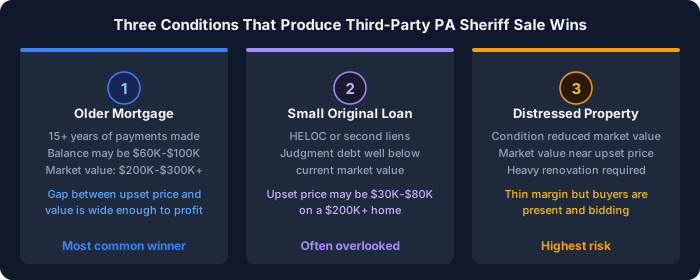
Older mortgages with significant principal paydown. A borrower who bought in 2007 for $175,000, made 15 years of payments before defaulting in 2022, may carry an outstanding principal of $60,000-$70,000. Add two years of interest and legal costs, and the upset price might reach $100,000-$110,000. If that property is worth $260,000 today, an investor who bids $170,000 is acquiring a 35% equity cushion. The bank still credit bids the upset price to protect themselves, but a motivated investor can outbid them and profit. The gap is wide enough to work.
Properties with smaller original loans. Not every defaulted loan is a 30-year $300,000 mortgage. Some PA foreclosures involve older purchase-money mortgages, home equity lines on otherwise unencumbered properties, or second liens on homes with strong equity. When the judgment debt is small relative to the property's current market value, the upset price is a low bar.
Distressed or damaged properties where market value has fallen. Occasionally, a property's condition deteriorates badly enough between origination and foreclosure that its market value has dropped close to or below the outstanding debt. These are complicated because the investor now has both a thin margin and a heavy renovation load. But they do clear, and they represent the properties that most closely resemble the Ohio model where investors compete on condition.
The pattern to watch for: long-established mortgages, pre-2015 originations in stable neighborhoods, borrowers who had meaningful equity before circumstances changed. Those produce clearable deals.
How to research PA sheriff sale listings before you bid
Pennsylvania counties do not publish property appraisals, so you're building your own comparable sales analysis before every bid. That changes the workflow considerably from Ohio, where the sheriff's appraisal gives you at least a starting point.
The upset price, however, is published. It appears in the sheriff's sale listing and in the court docket. Reading the docket is not optional. The judgment amount, the case history, the list of defendants, and any bankruptcy filings all affect the actual deal you're buying.
Specifically, look for:
- The judgment figure and what it includes. Sometimes costs are added after the original judgment entry. The number in the listing may be outdated.
- Named defendants. Every lienholder who was served in the foreclosure action has their lien extinguished by the sale. Lienholders who were not served keep their liens. The defendant list tells you who was in the case.
- Bankruptcy activity. A prior bankruptcy may have modified the judgment amount, discharged certain debts, or created a stay that added timeline and costs to the case.
- Property tax delinquencies. Real estate taxes survive a PA sheriff sale. Check with the county tax claim bureau for any outstanding balance.
This research is free. It's public record. Investors who skip it don't know what they're buying.
For market value, pull comparable sales from public records. PA counties have accessible sale records through the recorder of deeds. You can also pull county assessment data as a rough indicator, but PA assessed values are based on county schedules and may be significantly below current market. Never use the assessed value as a proxy for market value in PA.
What happens on auction day
PA sheriff sales run on a county-by-county schedule. Some counties hold six sales a year (bi-monthly), others run near-monthly. PA counties each set their own auction format and registration requirements. Investors should consult each county's sheriff website or court of common pleas directly for registration deadlines and deposit requirements specific to that county.
Registration requirements vary by county. You typically need to register in advance and have a certified check or cash available for the deposit. If you win, the balance is generally due within 30 days, though the exact timeline is set by the court order confirming the sale.
One thing to expect: bidding on most PA properties will be brief. The lender's attorney or servicer submits the credit bid at the upset price, usually without competing offers. The properties that do attract third-party competition are the ones where the equity math works. When buyers are present and bidding against each other, it's because they've already determined the gap between upset price and market value is wide enough to support multiple profitable bids.
It's not unusual for a PA county auction to run through 20 or 30 properties in an hour, with 25 going to lenders via credit bid and five producing actual competitive bidding.
No redemption period: what PA investors get in return for the upset price hurdle
The upset price filter keeps most properties out of investors' hands. What it gives back is certainty on the properties that do clear.
Pennsylvania mortgage foreclosures have no post-sale redemption period. When you win a PA sheriff sale, you own the property. The former owner cannot come back after 90 days and buy it from you at the auction price. This is different from some tax-deed states, where redemption windows create ongoing uncertainty and valuation risk.
If you're moving to PA from a state with extended redemption periods, adjust your assumptions. The upset price math is the gatekeeper. Once you're through it, the transaction is clean.
Title and lien considerations
PA sheriff sales extinguish most junior liens, but only when the case was properly served on the lienholder. Junior mortgage lenders, judgment creditors, and mechanic's lien holders named as defendants in the foreclosure action are divested from the property at the sale. Their interests transfer to the sale proceeds, not to the property itself.
The exception is any lienholder who was not properly served. Their lien may survive. This is more common than investors expect, particularly in older cases where addresses had changed or service was attempted by publication.
Pennsylvania Rule of Civil Procedure 3135(c), amended in 2014, provides a remedy: the plaintiff, assignee, or purchaser after the sale can petition the court to divest the improperly-noticed lienholder and either conduct another limited sheriff's sale where only that lienholder may bid, or seek other court-approved relief. This is not the same as a quiet title action. It's a specific statutory procedure for curing notice failures, but it takes time and adds cost.
Property taxes and municipal liens (demolition costs, code violation fines certified to the tax books) survive PA sheriff sales. Always run a tax certificate check through the county tax claim bureau before bidding.
Title insurance is available on PA sheriff sale properties when the title examination is clean. If there are notice issues with junior lienholders, a title company may require the Rule 3135(c) petition to be resolved before insuring. Factor that into your timeline.
Mistakes investors make at PA sheriff sales
Not knowing the upset price before bidding. This is the basic one. The upset price is public record. Know it before the auction. Walking in without that number, then bidding based on how the property looks or what you think it's worth, is how investors overpay at PA sales.
Treating the clearance rate as a quality signal. A county running 5% clearance doesn't have bad properties. It has properties where the upset prices are close to or above market value. The best deals in a 5% clearance county are the 5% that cleared. Find those; ignore the other 95%.
Skipping the docket. The case number is on the listing. The docket is public. Investors who don't read it are missing the defendant list, the judgment figure, and any bankruptcy history. These are not trivial details.
Applying Ohio assumptions to PA. Ohio's 2/3 minimum bid, the sheriff's appraisal as a price anchor, the prevalence of competitive third-party bidding: none of these translate directly to PA. PA requires building your own market value analysis and running your own upset price math. It's more legwork, which is part of why there's less competition.
Underestimating transfer taxes. Pennsylvania's transfer tax is 2% of the sale price, split between state and local. Some municipalities add local transfer taxes on top of that. Build this into your acquisition cost before you bid.
FAQ
What is the PA sheriff sale upset price? The upset price is the minimum bid at a Pennsylvania sheriff sale. It equals the total judgment debt: the outstanding loan principal, plus accrued interest, plus attorney fees, plus court costs. A third-party buyer must bid at least this amount to purchase the property.
Why do banks win most PA sheriff sales? Lenders submit credit bids equal to the upset price, paying nothing because the bid offsets their own debt. When the upset price is close to or above a property's market value, no investor can outbid the bank and still profit. That describes most of the properties on any given PA sheriff sale docket.
How do I know if a PA property's upset price is below market value? The upset price is in the sheriff sale listing and the court docket. Build an independent market value estimate using comparable sales from county recorder records. If the spread between your market value estimate and the upset price is wide enough to cover transfer taxes, holding costs, and your required return, it's worth pursuing.
Is there a redemption period after a PA sheriff sale? No. Pennsylvania mortgage foreclosures have no post-sale redemption period. When you win the auction, the sale is final.
What liens survive a PA sheriff sale? Real estate taxes and municipal liens certified to the tax duplicate always survive. Junior mortgage and judgment liens are extinguished if the holder was properly named and served in the foreclosure. If a lienholder was not properly served, their lien may survive. Rule 3135(c) provides a procedure for curing those notice defects post-sale.
See PA sheriff sale clearance data on AuctionScout
We cover seven Pennsylvania counties and update clearance data weekly. The county recap pages show which auction dates are producing third-party sales, what properties are selling at, and how clearance rates trend over time.
A county running 15% clearance has real opportunities flowing through the upset price filter. One running 3% doesn't have many. That's your first screen.
Start a free 14-day trial at auctionscout.app. No credit card required.