Nobody has published a real cross-state foreclosure auction ROI comparison. Not because investors don't want it — because almost nobody has auction data across multiple states to do it.
AuctionScout tracks 134 counties across three states: 88 in Ohio, 39 in Florida, and 7 in Pennsylvania. That dataset makes a true apples-to-apples comparison possible for the first time. This guide is it.
Here's what the numbers show, and what they mean for investors deciding where to deploy capital in 2026.
Why This Comparison Matters
Most foreclosure investing content stays state-specific. You'll find "how to invest in Ohio sheriff sales" and "Florida foreclosure auction guide" as separate articles, written by people who know one market. Cross-state comparisons are either anecdotal ("I've done deals in both") or oversimplified ("Ohio is cheap, Florida has beaches").
Neither helps you decide where to focus your next six months of deal flow.
The question investors actually ask: If I'm going to invest time and capital in learning a new market, which state offers the best data-backed ROI profile?
That's what this guide answers.
The Dataset: AuctionScout's 134 Counties
What we track:
- Listed properties per sale
- Sold to investors vs. returned to lender (credit bid / certificate of title to plaintiff)
- Sale prices and opening bid amounts
- Implied discount to estimated market value where data is available
- Auction frequency and volume trends
Coverage as of September 2026:
- Ohio: 88 of 88 counties
- Florida: 39 counties (primarily major metro and coastal markets)
- Pennsylvania: 7 counties (Allegheny, Philadelphia, York, Lancaster, Dauphin, Chester, Berks)
This isn't a national scraped dataset. It's transaction-level data from actual auction results in each county.
Ohio Deep-Dive: High Volume, High Clearance
Ohio sheriff sales are the most investor-accessible foreclosure auction market in our dataset. Here's why.
How Ohio Sales Work
Ohio sheriff sales are administered by the County Sheriff under Ohio Revised Code. Key mechanics:
- Minimum bid: Two-thirds of the court-appraised value (the "2/3 minimum")
- Deposit: Varies by bid amount; ORC-defined tiers ($2,000 under $10K; $5,000 from $10K–$200K; $10,000 above $200K — verify current requirements with each county)
- Lien survival: Most junior liens are extinguished at sheriff sale; first mortgage position property reverts clean
The 2/3 minimum is a critical investor advantage. Properties that are underwater don't get listed with an upset price that exceeds market value — the court appraisal creates a realistic entry floor.
Ohio Sale Rate Data
| County | Avg Sale Rate | Notes |
|---|---|---|
| Cuyahoga | 68–72% | Cleveland metro, high volume |
| Franklin | 63–70% | Columbus, large inventory |
| Hamilton | 65–75% | Cincinnati area |
| Montgomery | 60–68% | Dayton market |
| Summit | 66–74% | Akron metro |
| Lucas | 62–70% | Toledo |
Ohio statewide average (AuctionScout 88-county dataset): 60–75% sale rate
When 60–75% of listed properties sell at sheriff sale, investors are finding deals consistently. The market clears. The 2/3 minimum bid structure is the primary driver — lenders don't retain hopeless properties as often because the opening bid is set at a realistic level.
Ohio ROI Profile
- Typical discount to market value: 15–35% on sold properties
- Average post-auction acquisition costs: ~$3,000 (deed recording, title search, minor administrative)
- Time to possession: 30–60 days post-confirmation; faster than FL or PA
- Data availability: Excellent — 88 counties tracked, consistent sale formats
Florida Deep-Dive: Higher Costs, Strong Discount Depth
Florida's foreclosure auction system is structurally different from both Ohio and Pennsylvania. Understanding the mechanics is essential before comparing ROI.
How Florida Foreclosure Auctions Work
Critical terminology: Florida runs foreclosure auctions, not sheriff sales. These auctions are administered by the Clerk of the Circuit Court — not the county sheriff. If you're researching Florida, search "Florida foreclosure auction" or "[county] clerk of court auction." Never search "Florida sheriff sale."
Key mechanics:
- Online auctions: Florida foreclosure auctions are conducted online through platforms like RealAuction or Bid4Assets, depending on the county
- Opening bid: Set by the plaintiff (lender); can be as low as $100 in some cases
- 5% deposit: Required at time of winning bid
- Certificate of title: Issued by the Clerk of Court after 10-day objection period
- Carrying costs: Florida's higher insurance costs and property tax rates push post-acquisition holding costs up
Florida Sale Rate Data
| County | Avg Sale Rate | Notes |
|---|---|---|
| Duval (Jacksonville) | ~68% | Strong investor market |
| Pinellas (St. Pete) | ~69% | Active online bidding |
| Broward (Ft. Lauderdale) | 60–65% | High price points |
| Miami-Dade | 55–65% | High competition, luxury + distressed mix |
| Hillsborough (Tampa) | 63–70% | Growing investor interest |
Florida tracked-county average (AuctionScout 39-county dataset): 58–70% sale rate
Strong clearance rates — comparable to Ohio's top counties in some markets.
Florida ROI Profile
- Typical discount to market value: 20–40% on sold properties; deeper discounts available than Ohio in some markets
- Average post-auction acquisition costs: ~$18,000 (higher insurance premiums, property taxes, potential HOA arrears, Clerk fees)
- Time to possession: 30–60 days post-title issuance; can extend with contested titles
- Data availability: Good across major counties; smaller counties less consistent
Pennsylvania Deep-Dive: Low Clearance, Structural Barriers
Pennsylvania is the outlier in this dataset. Understanding why is more useful than the raw numbers.
How Pennsylvania Sheriff Sales Work
PA sheriff sales are administered by the County Sheriff under Pennsylvania's foreclosure statutes. The critical mechanic is the upset price.
- Upset price: The opening bid equals the total debt owed — mortgage balance, delinquent taxes, attorney fees, court costs. There is no court appraisal discount.
- Credit bids: When the upset price exceeds market value, the lender bids the amount owed without transferring cash. The property returns to the lender as REO.
- 10% deposit: Typically required at the time of sale
- Deed delivery: 30–60 days post-sale after confirmation period
The upset price mechanic is why PA sale rates are structurally low. It's not market timing — it's the system design.
Pennsylvania Sale Rate Data
| County | Avg Sale Rate | Notes |
|---|---|---|
| York | ~17% (Aug 2026) | 22 sold of 130 listed |
| Lancaster | ~15% | Similar credit bid pattern |
| Allegheny (Pittsburgh) | 18–22% | Marginally higher volume |
| Philadelphia | Varies | Complex municipal lien overlay |
Pennsylvania 7-county average (AuctionScout dataset): 15–22% sale rate
83% of properties in a typical PA county return to the lender. Investors are sorting through large lists to find the subset where the upset price is realistic.
Pennsylvania ROI Profile
- Typical discount to market value: Variable; when deals happen, discounts can be 25–40%, but the pipeline is thin
- Average post-auction acquisition costs: ~$8,000 (deed costs, title insurance, potential municipal lien resolution in urban markets)
- Time to possession: 30–60 days post-confirmation
- Data availability: Limited — 7 counties tracked; statewide data is sparse compared to OH/FL
Sale Rate Comparison: Why the Gap Matters
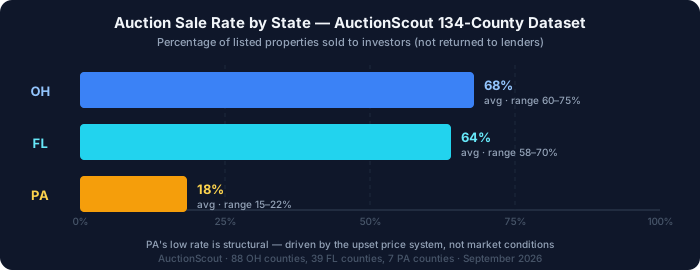
Ohio's 68% average sale rate means investors showing up consistently find acquisitions. Pennsylvania's 18% average means 82% of your research time goes toward properties that will never transact. That research overhead is a real cost — even if the deals you do find in PA carry lower competition.
Head-to-Head ROI Table
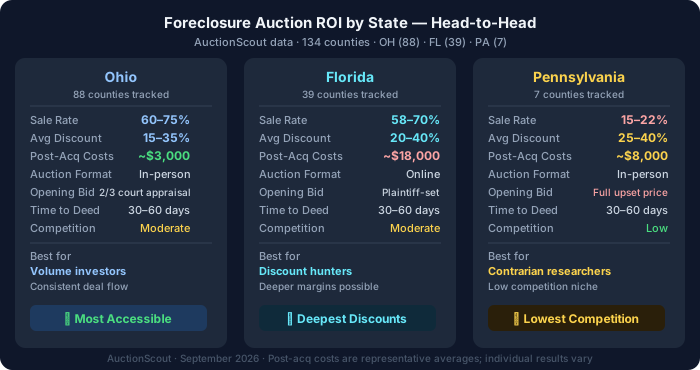
| Metric | Ohio | Florida | Pennsylvania |
|---|---|---|---|
| Avg sale rate | 60–75% | 58–70% | 15–22% |
| Typical discount to market value | 15–35% | 20–40% | 25–40% (when available) |
| Avg post-auction costs | ~$3,000 | ~$18,000 | ~$8,000 |
| Time to possession | 30–60 days | 30–60 days | 30–60 days |
| Counties tracked (AuctionScout) | 88 | 39 | 7 |
| Data availability | Excellent | Good | Limited |
| Investor competition | Moderate | Moderate | Low |
| Auction format | In-person | Online | In-person |
| Opening bid mechanism | 2/3 court appraisal | Plaintiff-set | Full upset price (total debt) |
Which State Wins? A Framework for Your Investor Profile
There's no universal answer. The right state depends on your investment profile.
Best for: Volume investors who want consistent deal flow
→ Ohio
Ohio's 60–75% sale rates mean you can attend auctions regularly and find acquisitions. The 2/3 minimum bid creates realistic entry points. Post-auction costs are low. If you want a market where showing up at sheriff sales consistently produces deals, Ohio is the answer.
Best starting counties: Franklin (Columbus), Cuyahoga (Cleveland), Hamilton (Cincinnati).
Best for: Investors seeking maximum discount depth
→ Florida
Florida's deeper discounts (20–40%) and lower competition in non-metro counties can produce better per-deal returns than Ohio — if you can absorb the higher carrying costs ($18K average post-acquisition). The online auction format also means you can participate without being physically present.
Best starting counties: Duval (Jacksonville), Pinellas (St. Pete), Hillsborough (Tampa).
Best for: Contrarian investors willing to do more research
→ Pennsylvania
PA's 15–22% sale rates create a low-competition environment. Investors who do rigorous pre-sale analysis — identifying the subset of properties where the upset price is genuinely below market value — find deals with almost no competition in the room. It requires more homework per deal, but that homework creates an edge.
Best starting counties: Allegheny (Pittsburgh), York, Lancaster.
The hybrid case
If you're already active in one state, the data suggests a diversification argument: Ohio investors have proven deal flow and can add Florida's discount depth at a higher cost basis. Pennsylvania's low competition makes it a specialty play for investors who can absorb the research overhead.
Frequently Asked Questions
What is a good foreclosure auction ROI? ROI varies by strategy (flip vs. hold) and market. The data metrics that matter most are: discount to ARV at the time of purchase, post-acquisition costs (including carrying costs and repairs), and time to disposition. Sale rate is a proxy for market accessibility — higher sale rates mean more consistent deal flow.
Is Ohio or Florida better for foreclosure investing in 2026? Ohio offers more consistent volume and lower post-acquisition costs. Florida offers deeper discounts in many markets but higher carrying costs and more complex title issues in some counties. The right answer depends on your capital available and whether you can handle Florida's higher ~$18K average post-auction cost structure.
Why is Pennsylvania's sale rate so low? Pennsylvania uses an "upset price" system where the opening bid equals the total debt owed. When properties are underwater — the debt exceeds market value — the lender credit bids and takes the property back. This is structural, not cyclical. It's not a sign of a depressed market; it's how the PA system is designed.
Can I invest in all three states from one platform? AuctionScout tracks auction results in all three states. You can monitor upcoming sales, historical sale rates, and county-level data across OH, FL, and PA from a single dashboard.
Which state has the least investor competition? Pennsylvania, by a significant margin. The high research burden (sorting through 80%+ credit bids) keeps competition low. Investors who do that work find genuine bargaining opportunities.
How do I start with foreclosure auction investing? Pick one state, learn its legal mechanics thoroughly, and start tracking results in 2–3 counties before bidding. AuctionScout's county recap pages provide historical sale data to help you calibrate before you commit capital.
Bottom Line
The three-state comparison data points to a clear pattern: Ohio is the most accessible market for consistent deal flow, Florida offers the deepest discount potential at higher carrying costs, and Pennsylvania is a high-research, low-competition specialty market.
No competitor publishes this comparison because no competitor has auction-specific data across all three states. AuctionScout does.
Start tracking auctions across Ohio, Florida, and Pennsylvania — all from one dashboard — at AuctionScout. County recap pages for each of our 134 tracked counties are updated after every sale.
Data sources: AuctionScout auction tracking database, September 2026. 134 counties across OH (88), FL (39), PA (7). Sale rate figures represent averages across tracked sales; individual county results vary. Post-auction cost estimates are representative averages and will vary by property condition, location, and investor strategy. Consult a licensed real estate attorney in each state before bidding.