An investor buys a property at a Florida foreclosure auction for $38,000. The house is worth $180,000. Looks like a steal. Then the bank sends a letter: there's a $152,000 first mortgage still on the property, and you now owe it. The investor didn't buy a house at a 79% discount. They bought someone else's mortgage payment.
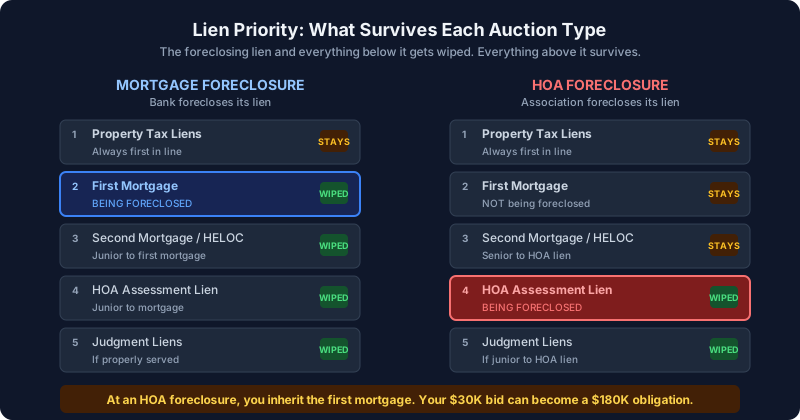
This happens because the investor didn't understand the difference between a Florida HOA foreclosure and a mortgage foreclosure. These are two completely different auction types with completely different outcomes for the buyer. At a mortgage foreclosure, the lender is foreclosing its lien, and junior claims get wiped (with caveats). At an HOA foreclosure, the homeowners association is foreclosing its assessment lien, which is almost always junior to the first mortgage. That mortgage survives the sale. You inherit it.
We track foreclosure auctions across 39 Florida counties, and this confusion shows up constantly. BiggerPockets threads about FL auctions routinely feature investors giving each other contradictory advice about which liens survive. Some of that advice is dangerously wrong.
Below: how the two auction types work, why lien priority determines what you're actually buying, and how to screen properties before you bid.
What you need to know first
A few terms to get straight before we dig in. If you're coming from Ohio (where we cover all 88 counties), some of this will feel familiar, but the FL-specific rules are different enough to trip you up.
Foreclosure auction (FL term): In Florida, these are called foreclosure auctions or foreclosure sales. They're run by the Clerk of the Circuit Court in each county. Not the sheriff. This is different from Ohio and Pennsylvania, where the county sheriff runs the sale. If someone says "Florida sheriff sale," they're using the wrong term, and it might mean they're also confused about the process.
Lien priority: The order in which claims against a property get paid. Think of it like a line. First in line gets paid first. If the sale price doesn't cover everyone, the people at the back get nothing. This order also determines what happens to each lien after a foreclosure sale.
HOA lien: When a homeowner stops paying their HOA or condo association assessments, the association can place a lien on the property. In Florida, the association can then foreclose on that lien, forcing a sale. But the HOA's lien is junior to the mortgage in most cases.
First mortgage: The primary loan used to buy the property. It was recorded first, and it sits first in the lien priority line (after property taxes). This matters enormously.
How mortgage foreclosure works in Florida
When a borrower stops paying their mortgage, the lender (bank, servicer, whoever holds the note) files a foreclosure lawsuit. Florida uses judicial foreclosure, meaning the case goes through the court system. A judge issues a final judgment of foreclosure, and the Clerk of Court schedules the sale.
At the sale, the lender typically bids up to or near the judgment amount. If an outside bidder (that's you) wants the property, you have to outbid the lender.
The lien survival question comes down to this: the lender is foreclosing the first mortgage. Because the mortgage is the senior lien (behind property taxes), the foreclosure wipes out most junior claims. That includes second mortgages, home equity lines of credit, judgment liens, and in many cases the HOA's assessment lien, assuming those lienholders were properly served in the lawsuit. If a junior lienholder wasn't named in the foreclosure action and properly served, their lien can survive. Always check the case docket.
What does NOT get wiped at a mortgage foreclosure sale:
- Property tax liens. Taxes are always first in line in Florida, same as everywhere.
- Any lien senior to the one being foreclosed. If a property somehow has a lien recorded before the first mortgage, it survives.
- Liens held by parties not properly served. This is why you pull the court file and check every named defendant.
So when you buy at a mortgage foreclosure auction, you are generally getting the property free of the mortgage and most junior claims, subject to taxes and any liens that weren't properly addressed in the lawsuit. This is what most investors picture when they think "foreclosure auction."
How HOA foreclosure works in Florida, and why it's a trap
Now the dangerous one. When a homeowner stops paying their HOA dues or condo association assessments, the association can foreclose on its assessment lien. Florida statutes (Chapter 720 for HOAs, Chapter 718 for condominiums) give associations this right.
The process looks similar on the surface. The association files a lawsuit, gets a judgment, and the Clerk of Court schedules a sale. The property goes to the highest bidder. It feels like the same thing.
It is not the same thing.
The HOA's assessment lien is almost always junior to the first mortgage. When the HOA forecloses, it is only foreclosing its own lien. The first mortgage is not being foreclosed. It is not being addressed at all. It survives the sale completely intact.
Read that again: the first mortgage survives an HOA foreclosure sale.
You buy the property. You own it. You also owe the bank the entire remaining balance on the mortgage you didn't foreclose. If the homeowner owed $150,000 on their mortgage and you bought the property at the HOA foreclosure sale for $30,000, you now have a property with a $150,000 mortgage on it. Your total cost is $180,000 for a house that might be worth $180,000. Your "deal" evaporated.
It gets worse. Once the bank realizes the property changed hands, they may accelerate the mortgage (demand the full balance immediately) or begin their own foreclosure. Now you're either paying off someone else's mortgage in full or losing the property you just bought, plus the $30,000 you paid at the HOA sale.
The "super lien" wrinkle for condos
Florida's condo statute (F.S. 718.116) gives condo associations a limited priority lien for up to 12 months of unpaid assessments or 1% of the original mortgage amount, whichever is less. This is sometimes called a "super lien" because it can take priority over the first mortgage for that limited amount.
But this does not mean the condo association's foreclosure wipes the mortgage. It means the association has a small priority claim for recent assessments. The super lien is about the HOA getting paid a portion when the bank eventually forecloses. It does not change the fundamental rule: HOA foreclosure does not wipe the first mortgage.
Some investors hear "super lien" and think it means the HOA sale clears the mortgage. It does not.
Side-by-side comparison
| Mortgage foreclosure | HOA foreclosure | |
|---|---|---|
| Who is foreclosing | The lender (bank/servicer) | The HOA or condo association |
| What lien is being foreclosed | The first mortgage | The HOA assessment lien |
| Does the first mortgage survive? | No (it's being foreclosed) | Yes, fully intact |
| Do junior liens get wiped? | Generally yes, if properly served | Only liens junior to the HOA lien |
| Typical price range | 60-80% of market value | Often very low (because mortgage survives) |
| Your actual cost | Purchase price + surviving liens | Purchase price + the entire first mortgage + other surviving liens |
| Risk level | Moderate (standard auction risk) | Very high if you don't check |
How to tell which type you're looking at
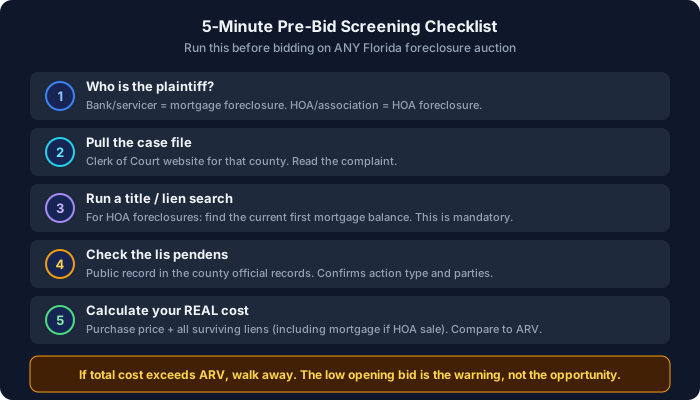
Before you bid on any Florida foreclosure auction, you need to know who filed the lawsuit. This is the single most important piece of due diligence you can do, and it takes five minutes.
Step 1: Check the plaintiff. Pull up the case on the county Clerk of Court's website. The plaintiff is whoever filed the foreclosure action. If the plaintiff is a bank, loan servicer, or mortgage company (Chase, Wells Fargo, Nationstar, etc.), it's a mortgage foreclosure. If the plaintiff is an HOA, a condo association, or a property management company acting on behalf of an association, it's an HOA foreclosure.
Step 2: Read the complaint. The complaint will state what lien is being foreclosed. A mortgage foreclosure complaint references the mortgage and note. An HOA foreclosure complaint references unpaid assessments and the association's lien.
Step 3: Run a title search. Even on mortgage foreclosures, you want to know what else is on the property. But on HOA foreclosure auctions, a title search is mandatory. You need to know the balance of the surviving first mortgage. Without that number, you cannot calculate your actual cost.
Step 4: Check the lis pendens. Florida requires a lis pendens (notice of pending litigation) to be recorded. The lis pendens will identify the type of action and the parties involved. This is public record, searchable through the county's official records.
Step 5: Calculate your real cost. For mortgage foreclosures: purchase price + property taxes owed + any surviving liens. For HOA foreclosures: purchase price + the full remaining mortgage balance + property taxes owed + any other surviving liens. If the total exceeds what the property is worth, walk away.
Common mistakes that cost investors money
Mistake 1: Assuming every foreclosure auction is a mortgage foreclosure. This is the big one. The auction listing on the Clerk of Court's sale calendar may not clearly label whether it's an HOA or mortgage action. You have to check the case file yourself.
Mistake 2: Confusing tax deed sales with foreclosure auctions. Florida has both. Tax deed sales are a separate process where the county sells properties for unpaid property taxes. These are NOT the same as foreclosure auctions and have different rules about what survives the sale. AuctionScout covers mortgage/judicial foreclosure auctions. Tax deed sales are a different animal.
Mistake 3: Trusting forum advice without checking statutes. We found BiggerPockets threads about Florida foreclosure auctions where two experienced investors gave opposite answers about whether junior liens survive. Both sounded confident. One was wrong. Florida's lien priority rules are specific to the type of foreclosure, the type of lien, and whether each lienholder was properly served. Generic advice from forums isn't enough.
Mistake 4: Bidding based on the low price without asking why it's low. If a property worth $200,000 has an opening bid of $12,000, ask yourself: why is nobody else bidding? Often the answer is that it's an HOA foreclosure and every experienced local investor knows the mortgage survives. The low price IS the warning sign.
Mistake 5: Applying Ohio rules to Florida. If you're expanding from Ohio to Florida, resist the urge to assume the rules transfer. Ohio's sheriff sale process, deposit tiers, minimum bid rules, and lien survival rules are specific to Ohio statutes. Florida has its own framework. The fundamentals of lien priority are similar, but the details differ enough to matter.
Screening checklist before you bid on any FL foreclosure auction
Use this every time. It takes 15 minutes and can save you from a six-figure mistake.
- Identify the plaintiff. Bank/servicer = mortgage foreclosure. HOA/association = HOA foreclosure.
- Pull the case file from the Clerk of Court website for the county.
- Read the complaint to confirm what lien is being foreclosed.
- Run a title search or property lien search. At minimum, check the county's official records for recorded mortgages.
- If it's an HOA foreclosure, find the current mortgage balance. Call the servicer if needed.
- Calculate total cost: purchase price + all surviving liens and obligations.
- Compare total cost to your estimated after-repair value. If the numbers don't work, pass.
- Check whether all lienholders were named as defendants in the foreclosure action.
FAQ
Can I buy at an HOA foreclosure sale and then negotiate with the bank? You can try. Some investors buy at HOA foreclosure sales with a plan to negotiate a short payoff with the mortgage holder. This is a strategy, not a guarantee. The bank has no obligation to discount the mortgage just because you bought the property at an HOA sale. You're betting you can negotiate from a weak position, and if the bank says no, you either pay full price or lose the property when they foreclose. This is not a beginner strategy.
Does the bank always foreclose after an HOA sale? Not always, but usually. If you're current on the mortgage payments (meaning you start making payments after buying), the bank may leave you alone. But if the previous owner was behind on payments (which is likely, since they weren't even paying their HOA dues), the bank will likely accelerate or foreclose. Assume the bank will act.
How do I find out the mortgage balance on a property going to HOA foreclosure? Start with the county official records. You can find the original mortgage amount and the recording date. For the current balance, you may need to contact the servicer or get a payoff letter. Some title companies will run this for you for a fee. It's worth the $100-200 to know whether you're walking into a $150,000 obligation.
Are condo association foreclosures the same as HOA foreclosures? The mechanics are similar, but the statutes are different. Condos fall under Florida Statute 718, HOAs under 720. Condo associations have the limited "super lien" priority mentioned earlier. But the core rule is the same for both: the first mortgage survives.
Does AuctionScout show whether an auction is HOA or mortgage? We track foreclosure auctions across 39 Florida counties and provide property-level data. You can use our county tracking to monitor upcoming sales in counties like Miami-Dade, Broward, Hillsborough, and Orange. For any property on the docket, always verify the auction type through the Clerk of Court case file using the steps above.
The one rule that protects you
Every other piece of advice in this guide flows from one rule: check who is foreclosing and what lien they're foreclosing on. If the HOA filed the case, the mortgage survives. If the bank filed the case, it doesn't. Five minutes of checking the court file separates a good deal from a catastrophic mistake.
Florida's foreclosure auction market is growing. Filings hit 27,494 in the first half of 2026, up 33% year over year, and more properties are hitting Clerk of Court dockets across the state. More inventory means more opportunity for investors who do their homework. It also means more HOA foreclosures mixed into the docket alongside mortgage foreclosures.
Set up county alerts on AuctionScout for the FL counties you're watching. Then do the five-minute check on every property before you bid. That's it.