
Ohio investors have two distinct paths to profit from distressed property: tax lien certificates and sheriff sale auctions. Most guides cover one or the other. This is the head-to-head comparison — the numbers, the risks, and the math on a real scenario in Montgomery County, where both formats operate side by side.
How Ohio tax lien certificates work
When a property owner falls behind on taxes, the county can sell a tax lien certificate at auction. The winning bidder pays the delinquent taxes, penalties, and fees. In return, they receive a certificate that earns 18% annual interest — guaranteed by Ohio Revised Code Section 5721.30.
Here's what makes tax liens attractive:
- 18% interest rate. This is fixed by statute, not negotiated. Even if the owner redeems the certificate one month after the sale, you collect 18% annualized on your investment.
- Priority position. Tax lien certificates take priority over mortgages, judgment liens, and most other encumbrances. Your claim sits at the top of the stack.
- Low minimum bids. The starting bid equals the delinquent taxes plus penalties and costs — often a few thousand dollars, sometimes less.
- Passive investment. You buy the certificate and wait. No property management, no rehab, no tenants.
The catch: 95% of Ohio tax liens are redeemed by the property owner. You get your principal back plus interest, but you don't get the property. For the remaining 5%, you must wait a mandatory 12-month period before initiating foreclosure proceedings to take ownership — and that process adds time and legal costs.
How Ohio sheriff sales work
Sheriff sales are court-ordered auctions of foreclosed properties. They come in two flavors in Ohio, and the minimum bid rules differ significantly:
- Mortgage foreclosure sales. A lender forecloses, and the property sells at auction. The minimum bid is two-thirds of the appraised value.
- Tax foreclosure sales. The county forecloses for unpaid taxes. The minimum bid equals only the taxes owed — often far below market value.
Sheriff sale buyers get immediate ownership through a sheriff's deed. No waiting 12 months. No hoping the owner doesn't redeem. You win the auction, you own the property.
The trade-offs are real:
- Cash required at closing. Most Ohio counties require full payment within 30 days. A deposit is due on auction day — $2,000, $5,000, or $10,000 depending on the appraised value tier (ORC 2329.211).
- No interior inspection. You're bidding on a property you likely haven't walked through.
- Lien transfer risks. Property tax liens (ORC 5721.10), special assessments, water/sewer liens certified to the auditor (ORC 743.04, 729.49), municipal code violation liens certified to the tax duplicate, and federal tax liens (IRS retains 120-day redemption right) all survive the sale and transfer to you.
- Condition risk. Vacant properties deteriorate. Occupied properties may need eviction proceedings.
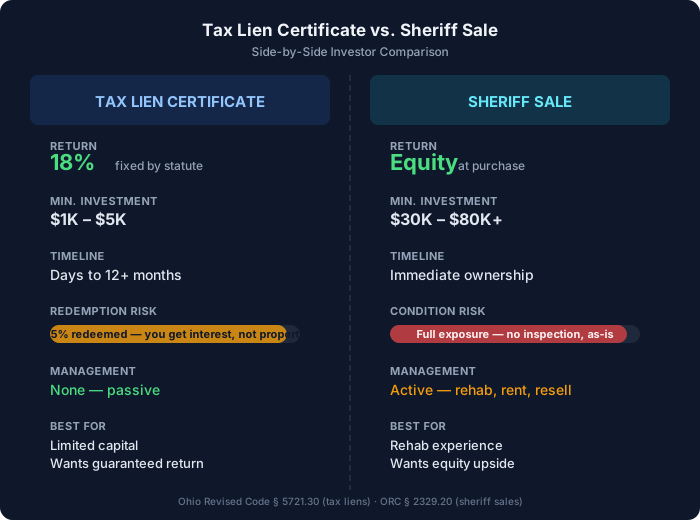
The numbers side by side
| Factor | Tax lien certificate | Sheriff sale |
|---|---|---|
| Return mechanism | 18% interest on certificate | Property equity at purchase |
| Minimum investment | Delinquent taxes owed (often $1,000–$5,000) | 2/3 appraised value (mortgage) or taxes owed (tax) |
| Time to return | Redemption: days to 12 months. Foreclosure: 12+ months | Immediate ownership at auction |
| Redemption risk | 95% are redeemed — you get interest, not property | No redemption period in Ohio sheriff sales |
| Property condition risk | None until you foreclose | Full exposure from day one |
| Capital requirement | Low | High (tens of thousands typical) |
| Due diligence burden | Title search recommended | Title search, property inspection, lien research critical |
| Management required | None | Active: rehab, rent, or resell |
| Lien priority | First position by law | Depends on foreclosure type — research required |
Montgomery County case study
Montgomery County (Dayton) runs both in-person tax lien certificate sales and online foreclosure sheriff sales, making it an ideal lab for comparing the two strategies on the same property.
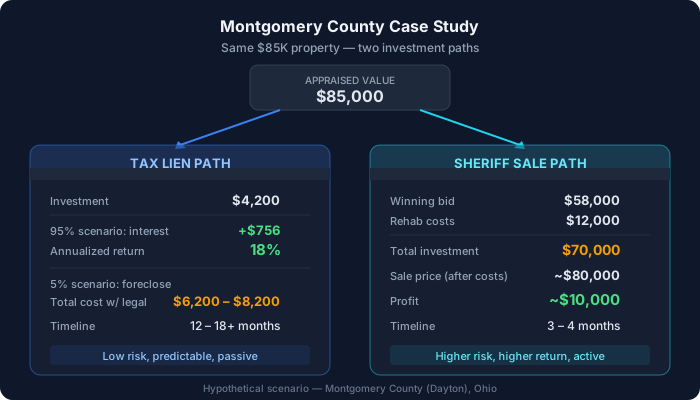
Take a hypothetical single-family home appraised at $85,000 with $4,200 in delinquent taxes.
Tax lien path:
- You bid $4,200 at the tax lien sale and win the certificate.
- Most likely outcome (95% probability): the owner redeems within 12 months. You receive $4,200 plus up to $756 in interest (18% annualized). Your annualized return: 18% on a $4,200 investment.
- Less likely outcome (5%): the owner doesn't redeem. After 12 months, you initiate foreclosure. Legal costs run $2,000–$4,000. Total investment: roughly $6,200–$8,200. If you obtain the property and it's worth $85,000, the upside is significant — but it took 18+ months and carried uncertainty.
Sheriff sale path:
- The property enters mortgage foreclosure. Minimum bid: two-thirds of $85,000 = $56,667.
- You bid $58,000 and win. You own the property immediately.
- The home needs $12,000 in repairs. Total investment: $70,000.
- After rehab, you sell for $85,000 (net roughly $80,000 after closing costs). Profit: approximately $10,000 in three to four months.
- Alternatively, you rent it for $950/month and hold for cash flow.
Same property, two completely different investment profiles. The tax lien path risks $4,200 for a likely 18% return. The sheriff sale path risks $70,000 for a larger dollar return but demands hands-on work and carries condition risk.
Which strategy fits you
Your choice comes down to three variables:
Available capital. Tax liens let you start with a few thousand dollars and spread risk across multiple certificates. Sheriff sales demand $30,000–$80,000+ per property in most Ohio counties.
Time horizon. Tax liens are a waiting game — 12 months minimum before you can act on unredeemed certificates. Sheriff sales produce results in weeks to months.
Risk tolerance. Tax lien interest at 18% is guaranteed by statute. You know the return if the owner redeems. Sheriff sales offer higher potential dollar returns, but you're absorbing rehab uncertainty, market risk, and the possibility of inheriting undisclosed liens or code violations.
| Investor profile | Better fit |
|---|---|
| Limited capital, wants passive income | Tax lien certificates |
| Wants guaranteed fixed return | Tax lien certificates |
| Has rehab experience, wants equity | Sheriff sales |
| Needs faster liquidity | Sheriff sales |
| Wants diversification across many properties | Tax lien certificates |
| Comfortable with property management | Sheriff sales |
Combining both strategies
Experienced Ohio investors don't choose one path — they run both simultaneously.
The playbook: allocate a portion of your capital to tax lien certificates for predictable, passive 18% yields. Use another portion for sheriff sale acquisitions where the numbers justify the hands-on work.
Tax lien interest payments fund your next sheriff sale deposit. Sheriff sale profits buy more certificates. The two strategies compound each other.
Start with tax liens if you're new to distressed property investing in Ohio. The capital requirements are lower, the downside is limited, and you learn the county auction process without risking a six-figure property bet. Once you've built familiarity with county systems, title research, and local market values, add sheriff sales to your strategy.
Track Ohio sheriff sales with AuctionScout
Whether you're building a tax lien portfolio, bidding at sheriff sales, or running both strategies, you need reliable data on what's coming to auction across Ohio counties.
AuctionScout monitors sheriff sale listings across Ohio, surfaces AI-powered property analysis, and helps you identify opportunities that match your investment criteria — before auction day.
Start your free trial and build your Ohio distressed property strategy with data, not guesswork.